
The Rise of the Partnership Marketing Campaign

A Partnership Marketing Campaign has become one of the most effective growth mechanisms for modern brands navigating saturated digital markets and increasingly skeptical audiences. Traditional advertising alone no longer delivers sustainable impact. Consumers now value credibility, relevance, and peer validation more than promotional noise.
In this environment, a well-structured Partnership Marketing allows brands to grow through collaboration rather than competition. By aligning with trusted partners, brands can unlock shared audiences, transfer trust, and accelerate visibility without relying solely on paid media.
This shift reflects a deeper change in human psychology. People trust recommendations, associations, and ecosystems far more than isolated brand claims. As a result, the Partnership Marketing is no longer a tactical experiment it is a strategic growth engine.
Understanding What a Partnership Marketing Campaign Really Is
A Partnership Marketing is a coordinated marketing initiative where two or more brands collaborate to achieve mutually beneficial goals such as audience expansion, lead generation, product adoption, or brand authority building.
Unlike one-off collaborations, a modern Partnership Marketing Campaign is structured, data-driven, and designed to scale. It operates within a defined framework that aligns messaging, channels, and performance metrics across partners.
At its core, this model transforms marketing from a solo activity into a network-driven growth system.
Core Components of a Partnership Marketing Campaign
- Shared objectives and success metrics
- Clearly defined partner roles and responsibilities
- Aligned brand values and audience fit
- Coordinated messaging and creative assets
- Transparent performance tracking
When these components work together, the Partnership Marketing Campaign delivers compounded impact rather than fragmented exposure.
Why Partnership Marketing Campaigns Work in the Modern Market
The effectiveness of a Partnership Marketing Campaign is rooted in contemporary consumer behavior. Digital audiences are overwhelmed by options and increasingly resistant to direct advertising.
Partnerships introduce a trust shortcut. When a trusted brand collaborates with another, it signals legitimacy and reduces perceived risk. This psychological mechanism accelerates decision-making and increases engagement quality.
Additionally, algorithms on search engines and social platforms favor content and brands that demonstrate authority, relevance, and real-world connections. A Partnership Marketing Campaign naturally supports these signals.
Strategic Objectives Behind a Partnership Marketing Campaign
Every successful Partnership Marketing Campaign begins with strategic clarity. Without clear objectives, partnerships become unfocused and difficult to measure.
Common Campaign Objectives
- Expanding reach into new customer segments
- Building brand credibility and authority
- Driving qualified leads and conversions
- Supporting product launches or market entry
- Increasing lifetime customer value
Each objective influences partner selection, messaging tone, and channel mix.
Partner Selection and Alignment Principles
The quality of partners determines the success of a Partnership Marketing Campaign. Large audiences alone are not enough.
Key Partner Evaluation Criteria
- Audience relevance and overlap
- Brand values and reputation
- Content and communication style
- Long-term collaboration potential
Strong alignment ensures that the campaign feels natural rather than transactional.
Designing Scalable Partnership Marketing Strategies
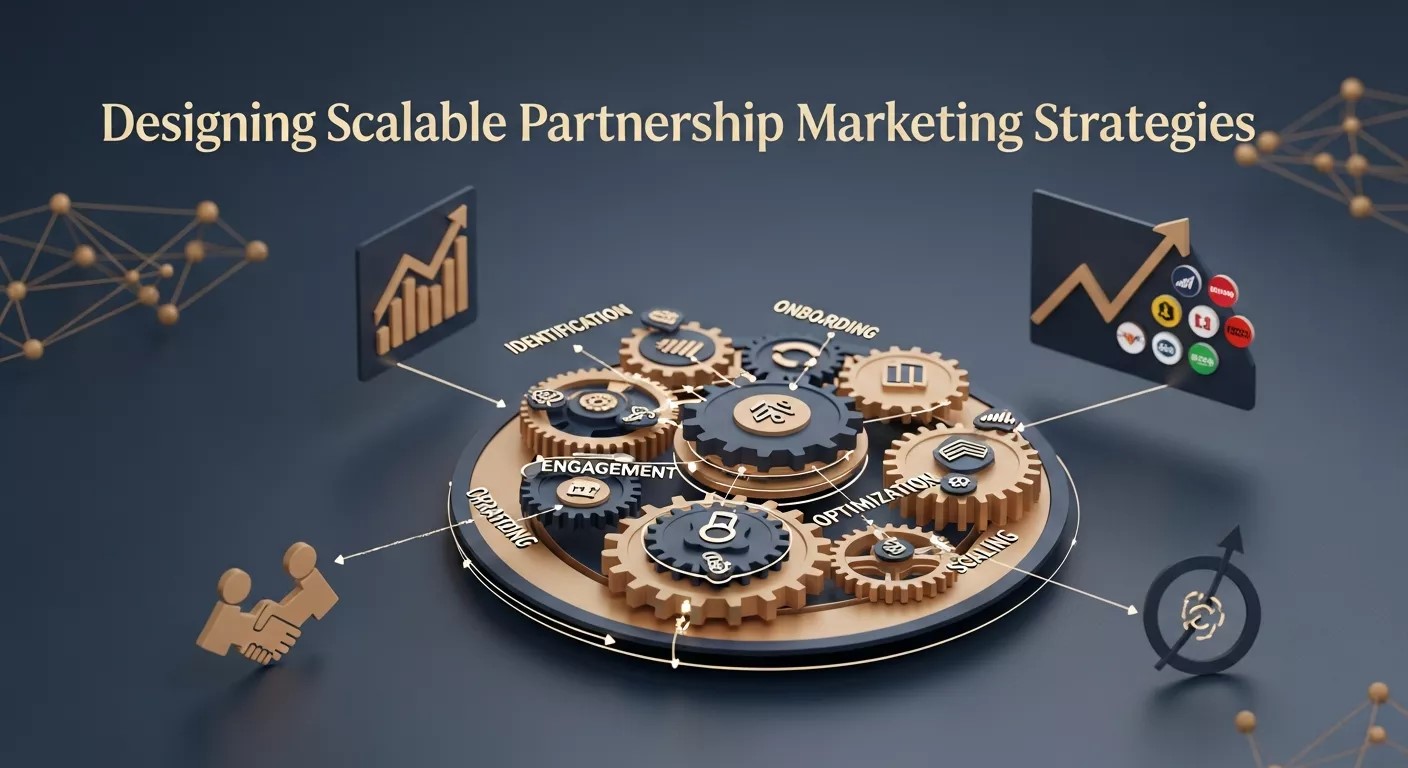
Scalability is what separates high-performing campaigns from short-lived experiments. Building repeatable Partnership Marketing Strategies allows brands to expand collaborations without losing consistency.
Framework-Based Campaign Design
Rather than reinventing each campaign, leading brands use standardized frameworks that define:
- Campaign structure and timelines
- Asset requirements
- Approval workflows
- Reporting formats
This systemized approach reduces friction and improves execution speed.
Channel Integration in a Partnership Marketing Campaign
A modern Partnership Marketing Campaign operates across multiple channels to reinforce messaging and maximize reach.
Common Activation Channels
- Co-branded content marketing
- Email list cross-promotion
- Social media collaborations
- Webinars and virtual events
- Affiliate and referral programs
Multi-channel activation ensures consistent exposure throughout the customer journey.
The Role of Data and Measurement
Data-driven execution is essential for optimizing a Partnership Marketing Campaign. Without measurement, partnerships risk becoming vanity initiatives.
Key Metrics to Track
| Metric Category | Focus Area |
|---|---|
| Reach | Partner audience exposure |
| Engagement | Clicks, shares, comments |
| Conversion | Leads, sales, sign-ups |
| Retention | Repeat interactions |
| Brand Impact | Trust and authority signals |
These insights guide future campaign refinement.
Leveraging Partnership Marketing Trends
Staying aligned with Partnership Marketing Trends helps brands maintain relevance and competitive advantage.
Ecosystem-Based Campaigns
Brands increasingly collaborate within ecosystems rather than isolated partnerships. These networks create compounding value and network effects.
Community and Creator Collaborations
Niche communities and creator-led partnerships often outperform broad-reach campaigns due to higher trust and engagement levels.
Crafting an Effective Partnership Marketing Proposal
An Effective Partnership Marketing Proposal is critical for securing high-quality partners and setting clear expectations.
Essential Proposal Elements
- Mutual value proposition
- Campaign scope and deliverables
- Audience insights
- Revenue or growth potential
- Measurement framework
A well-crafted proposal positions the campaign as a shared growth opportunity rather than a promotional request.
Execution Models for Partnership Marketing Campaigns

Execution quality determines campaign outcomes. Clear ownership and coordination are essential.
Centralized Campaign Management
Central teams or platforms manage assets, timelines, and communication to ensure consistency across partners.
Automation and Technology Support
Automation tools streamline onboarding, tracking, and reporting, enabling campaigns to scale efficiently.
Risk Management and Brand Safety
While powerful, a Partnership Marketing Campaign must be managed carefully to avoid reputational risk.
Brand Control Measures
- Clear co-branding guidelines
- Content approval processes
- Ongoing partner evaluation
Diversification Strategy
Relying on multiple partners reduces dependency and stabilizes growth.
Industry-Specific Applications of Partnership Marketing Campaigns
SaaS and Technology
Technology companies use partnership campaigns for integrations, reseller programs, and platform alliances to drive adoption and reduce churn.
Consumer and Retail Brands
Retail and consumer brands leverage co-branded campaigns and loyalty integrations to expand reach and emotional connection.
Financial Services and Fintech
Trust-driven partnerships help fintech brands accelerate adoption by associating with established institutions.
Integrating Partnership Marketing Campaigns with Broader Growth Strategy
A Partnership Marketing Campaign delivers maximum impact when aligned with content marketing, SEO, performance marketing, and product-led growth initiatives.
Integrated execution reinforces authority and improves long-term returns.
Organizational Readiness and Culture
Successful campaigns require internal alignment.
Cross-Functional Collaboration
Marketing, sales, product, and legal teams must work together to support partnerships effectively.
Partnership-First Mindset
Organizations that value collaboration over competition unlock greater long-term value.
Advanced Psychological Triggers in a Partnership Marketing Campaign
A high-performing Partnership Marketing Campaign leverages deep psychological triggers that influence how audiences perceive value, trust, and relevance. Understanding these triggers allows brands to design campaigns that resonate beyond surface-level promotion.
Social Proof and Authority Bias
When brands collaborate publicly, audiences interpret the partnership as a validation signal. Authority bias plays a key role here if a known or respected partner is involved, the campaign inherits perceived credibility. This reduces resistance and increases engagement quality.
Reciprocity and Shared Value
Effective campaigns emphasize mutual benefit. When users see partners offering value together such as exclusive access, bundled benefits, or shared knowledge they feel a stronger inclination to engage and reciprocate.
Audience Segmentation and Personalization in Partnership Campaigns
Modern Partnership Marketing Campaigns are no longer generic. Personalization and segmentation significantly improve performance.
Segment-Level Campaign Design
Brands can design variations of the same campaign for different audience segments across partners. Messaging, offers, and creative elements are adjusted based on audience intent, maturity level, and pain points.
Behavioral and Intent Signals
Data from partner platforms such as browsing behavior, content interaction, and purchase intent helps refine targeting and improves relevance across the customer journey.
Creative Collaboration and Co-Branding Excellence
Creative alignment is essential to campaign success. A Partnership Marketing Campaign must balance individuality with cohesion.
Co-Branded Content Guidelines
Clear creative frameworks ensure that both brands are represented authentically without diluting identity. This includes tone, visual hierarchy, and messaging priorities.
Storytelling Through Collaboration
Narrative-driven campaigns perform better than transactional promotions. Storytelling highlights why the partnership exists and how it benefits the audience.
Budgeting and Resource Allocation for Partnership Marketing Campaigns
One advantage of a Partnership Marketing Campaign is cost efficiency, but proper budgeting is still essential.
Shared Investment Models
Partners often split costs for content production, media amplification, and technology tools. Shared investment increases accountability and commitment.
Opportunity Cost Evaluation
Brands must evaluate not only direct costs but also opportunity costs—ensuring that partnership campaigns outperform alternative growth channels.
Legal, Compliance, and Contractual Considerations
As campaigns scale, legal clarity becomes increasingly important.
Partnership Agreements
Clear contracts define usage rights, responsibilities, timelines, and exit clauses. These agreements protect both brands and ensure long-term stability.
Compliance and Disclosure Standards
Transparency around partnerships supports regulatory compliance and strengthens audience trust.
Lifecycle Management of a Partnership Marketing Campaign
A Partnership Marketing Campaign evolves through distinct lifecycle stages.
Planning and Alignment Phase
This phase focuses on objectives, partner alignment, messaging, and measurement frameworks.
Execution and Optimization Phase
Campaigns are actively monitored and optimized based on real-time performance data.
Evaluation and Renewal Phase
Post-campaign analysis determines whether partnerships should be scaled, refined, or concluded.
Technology Stack Supporting Partnership Marketing Campaigns
Technology plays a central role in scaling and optimizing campaigns.
Partner Management Platforms
These tools centralize communication, asset distribution, and performance tracking.
Analytics and Attribution Tools
Advanced analytics platforms provide visibility into partner-driven impact across the funnel.
Competitive Differentiation Through Partnership Marketing Campaigns
In crowded markets, differentiation is critical. A Partnership Marketing Campaign enables brands to stand out through association rather than messaging alone.
Unique Value Positioning
Collaborative offerings create differentiated value propositions that competitors find difficult to replicate.
Barrier Creation
Strong partner ecosystems create switching costs and competitive barriers.
Scaling from Campaigns to Ecosystems
As maturity increases, individual Partnership Marketing Campaigns often evolve into long-term ecosystems.
From Tactical to Strategic Partnerships
Repeated successful campaigns lay the foundation for deeper integration and co-innovation.
Network Effects and Compounding Growth
Each additional partner increases ecosystem value, creating compounding growth dynamics.
The Future of the Partnership Marketing Campaign
The Partnership Marketing Campaign will continue to mature as brands prioritize collaboration over isolation. AI-powered partner matching, predictive analytics, and deeper product integrations will shape future campaigns.
Brands that treat partnership campaigns as strategic infrastructure rather than short-term promotions will achieve stronger resilience, relevance, and sustainable brand growth in the evolving digital economy.
Conclusion
A Partnership Marketing Campaign is no longer just a marketing tactic but a strategic growth engine for modern brands. Through aligned partners, data-driven execution, and ecosystem thinking, brands can build trust, scale efficiently, and maintain long-term competitive relevance.
Frequently Asked Questions (FAQ)
What is a Partnership Marketing Campaign?
A Partnership Marketing Campaign is a collaborative marketing initiative where two or more brands work together to achieve shared growth goals through combined audiences, trust, and resources.
How does a Partnership Marketing Campaign help brand growth?
It accelerates growth by leveraging partner credibility, expanding reach, reducing acquisition costs, and improving audience trust compared to standalone marketing efforts.
How is a Partnership Marketing Campaign different from influencer marketing?
Influencer marketing focuses on individuals, while a Partnership Marketing Campaign involves brand-to-brand collaboration with shared strategy, messaging, and long-term value creation.
What types of brands benefit most from Partnership Marketing Campaigns?
SaaS companies, consumer brands, fintech firms, marketplaces, startups, and service-based businesses benefit the most due to their need for scalable and trust-driven growth.
How do you choose the right partners for a campaign?
The right partners align in audience, brand values, market positioning, and growth vision. Strategic fit matters more than audience size.
What channels are commonly used in Partnership Marketing Campaigns?
Common channels include content marketing, email campaigns, social media collaborations, webinars, referral programs, and platform integrations.
How do you measure the success of a Partnership Marketing Campaign?
Success is measured through reach, engagement quality, conversions, customer lifetime value, retention, and long-term brand authority signals.
What role does trust play in Partnership Marketing Campaigns?
Trust is central. Partnerships enable trust transfer, reducing perceived risk and increasing engagement and conversion rates.
Can Partnership Marketing Campaigns be scaled?
Yes. With proper frameworks, automation tools, and standardized processes, Partnership Marketing Campaigns can scale efficiently across multiple partners.
What are the biggest challenges in running Partnership Marketing Campaigns?
Common challenges include partner misalignment, operational complexity, maintaining brand consistency, and accurately measuring long-term impact.
Is a Partnership Marketing Campaign suitable for startups?
Absolutely. Startups can use partnership campaigns to gain credibility, reach new audiences, and grow faster without large advertising budgets.
What is the future of Partnership Marketing Campaigns?
The future lies in ecosystem-based collaborations, AI partner discovery, advanced attribution models, and deeper integration between products, platforms, and communities.