Home Blog

Co-Marketing Campaigns That Work: 7 Inspiring Examples

0
Co-Marketing Campaigns

Strong partnerships have the power to unlock opportunities that a single brand could never reach alone. In modern marketing, collaborating with another company through co-marketing campaigns, brand partnerships, or joint promotional strategies can dramatically expand your audience, elevate your credibility, and drive measurable results.

Global leaders like GoPro, Red Bull, Spotify, HubSpot, Nike, and Apple have proven how effective brand collaborations can be when two complementary companies leverage their combined strengths.

By teaming up with a relevant, complementary brand, you gain access to a new customer segment, share creative and financial resources, and co-create campaigns that deliver more impact than any solo effort.

In this guide, we’ll dive into the power of brand collaboration, partnership marketing, and joint branded campaigns, showcase real-world examples that achieved standout success, and give you practical ideas to launch your own high-performing co-marketing initiatives.

What is a Co-Marketing Campaign?

Co-Marketing Campaign

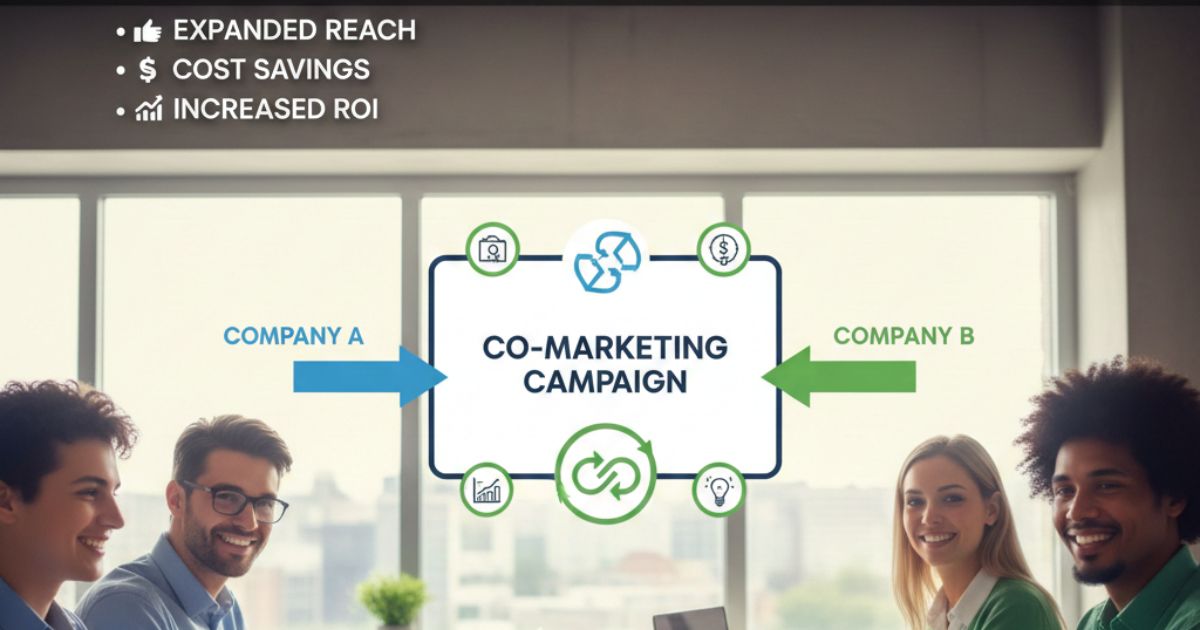
A co-marketing campaign is a strategic collaboration where two or more companies work together to promote a shared offer, message, or marketing initiative.

A co-marketing campaign is a strategic collaboration where two or more companies work together to promote a shared offer, message, or marketing initiative. It is different from co-branding. Co-branding focuses on creating a single product with both brand logos; co-marketing focuses on joint marketing efforts that amplify reach and impact.

In this type of campaign, each brand contributes marketing resources, such as content, social media channels, email lists, advertising budgets, or creative expertise. Both partners share the responsibility for creating and promoting the campaign, resulting in cross-promotion, audience growth, and lead generation for both sides.

The main goal is to leverage each other’s target audience to achieve measurable results, like increasing brand awareness, generating qualified leads, or driving sales conversions. The most successful co-marketing campaigns happen when the partner’s audience complements your own but does not compete directly. This creates a win-win partnership that adds value for both companies and their customers.

Choosing the right partner is key. A good co-marketing partner aligns with your brand values, customer interests, and marketing goals. With the right strategy, co-marketing campaigns become powerful tools to expand reach, strengthen credibility, and deliver more effective partnership marketing results than either brand could achieve alone.

The Pros and Cons of Co-marketing Campaign

Co-marketing campaigns have become one of the most powerful growth levers for modern brands. When two companies collaborate on content, distribution, and shared promotions, the results can scale quickly. But like every partnership marketing strategy, co-marketing has strengths and weaknesses. Understanding both sides helps you build smarter, high-ROI campaigns.

Pros of Co-Marketing 

1. Wider Brand Visibility

Partnering with another company gives you instant exposure to a new audience segment.
Your brand gets seen by people you normally wouldn’t reach, expanding overall visibility.

2. Lower Marketing Costs

Since both companies invest in the campaign, the cost burden becomes lighter.
You can run bigger, more polished campaigns without overspending.

3. Stronger Brand Trust

When a reputable brand stands beside you, customers trust your message more.
This association builds authority and increases consumer confidence.

4. Combined Creativity and Skillsets

Each brand brings its own strengths—creative ideas, industry insights, tools, and expertise.
This mix often leads to innovative campaigns that outperform solo efforts.

5. Improved Customer Response

Because customers recognize and trust both brands, they’re more likely to engage or purchase.
The combined influence boosts conversion rates and action-taking.

6. Bigger Projects at a Lower Cost

Pooling resources allows you to produce campaigns that might be too costly for one brand alone.
You gain scale, efficiency, and professional-level output.

Cons of Co-Marketing

1. Risk of Brand Identity Getting Blurred

Your brand voice may get overshadowed, especially if the partner’s branding is dominant.
This can weaken your distinct identity.

2. Shared Reputation Risks

If your partner faces criticism or a PR issue, your brand can be indirectly affected.
Negative associations can transfer quickly.

3. Heavy Coordination and Planning Needs

Co-marketing requires clear communication, shared timelines, and strict alignment.
Managing two teams and workflows can be time-consuming.

4. Brand or Audience Misfit

If the brands differ in audience, tone, values, or goals, the campaign loses impact.
Poor alignment leads to weak engagement and confusing messaging.

5. Reduced Control Over Messaging

You may have to compromise on how your message looks or sounds to satisfy both brands.
This limits creative freedom and dilutes impact.

6. Relying on Your Partner’s Performance

Your campaign’s success depends on how well the partner delivers their part.
If they fall behind, the entire project suffers.

Why Should You Run a Co-Marketing Campaign?
Co-Marketing Campaigns

Co-marketing campaigns offer a range of benefits that can significantly impact your business’s growth and visibility. Here’s why they are worth considering:

  • Cost-Effective Reach: By sharing the costs of content creation and promotion, both partners can execute a larger, more impactful campaign than they could afford individually. It’s a budget-friendly way to double your marketing power.
  • Access to New Audiences: The most significant advantage is the ability to connect with a new, highly targeted audience. Your partner’s followers already trust them, and that trust can extend to your brand through the association.
  • Enhanced Credibility: Partnering with a respected brand can boost your own credibility. This “halo effect” positions your company as an authority in your industry and builds trust with potential customers.
  • Shared Expertise and Resources: Two heads are often better than one. Co-marketing allows you to combine different skill sets, perspectives, and resources, leading to higher-quality content and more creative campaigns.
  • Lead Generation: Co-marketing efforts, especially those involving gated content like webinars or ebooks, are powerful lead-generation tools. You get access to your partner’s leads, effectively doubling your potential pipeline.

7 Examples of Successful Co-Marketing Campaigns

To illustrate what great co-marketing looks like, let’s explore some real-world examples of brands that have joined forces to create something special.

1. GoPro & Red Bull: “Stratos”

GoPro and Red Bull’s “Stratos” campaign is a legendary example of co-marketing. The partnership saw daredevil Felix Baumgartner jump from a space pod 24 miles above the Earth’s surface, all captured on GoPro cameras. Red Bull, known for its “gives you wings” slogan and association with extreme sports, was the perfect partner for GoPro, a brand whose cameras are designed to capture life’s most thrilling moments. The campaign was a massive success, generating billions of media impressions and cementing both brands as leaders in adventure and high-performance gear.

2. Spotify & Starbucks: Music for Your Mood

Spotify and Starbucks teamed up to enhance the in-store experience for coffee lovers. Through the Starbucks app, customers could discover music playing in the store and save it to a Spotify playlist. This partnership was a natural fit, as both brands cater to a similar audience that values curated experiences. It allowed Starbucks to offer a unique digital perk, while Spotify gained access to Starbucks’ vast customer base, encouraging app downloads and playlist engagement.

3. BuzzFeed & Best Friends Animal Society: “The Golden Ratio”

BuzzFeed, a master of viral content, partnered with the Best Friends Animal Society for a campaign centered on cats. Recognizing that cat videos are a cornerstone of their content, they created a video that playfully assigned a “golden ratio” score to different cats. The video was entertaining and highly shareable, but it also carried a call to action to support animal adoption through the Best Friends Animal Society. This campaign successfully blended humor with a meaningful cause, leveraging BuzzFeed’s massive reach for social good.

4. Uber & Spotify: “Soundtrack for Your Ride”

Another smart Spotify collaboration was its partnership with Uber. This co-marketing campaign allowed Uber riders to connect their Spotify accounts and control the music during their trip. It was a simple yet brilliant idea that enhanced the customer experience for both services. Uber differentiated itself from competitors by offering a personalized ride, while Spotify gained a unique platform to increase user engagement and showcase the value of its premium subscription.

5. HubSpot & Chatfuel: The Ultimate Guide to Chatbots

HubSpot, a leader in inbound marketing, often partners with other tech companies to create valuable educational content. One notable example is their co-authored ebook with Chatfuel, “The Ultimate Guide to Chatbots.” By combining HubSpot’s marketing expertise with Chatfuel’s specialization in chatbot technology, they created a comprehensive resource that appealed to both of their audiences. This co-marketing campaign positioned both companies as thought leaders and generated a significant number of leads through the gated ebook.

6. Apple & MasterCard: Apple Pay Launch

When Apple launched Apple Pay, it needed to build trust and encourage adoption. To do this, they partnered with MasterCard, a globally recognized and trusted financial services company. Their joint marketing efforts focused on the security, simplicity, and convenience of using Apple Pay. Commercials showed how easy it was to make purchases with a tap of an iPhone. This partnership was crucial for Apple Pay’s successful rollout, as MasterCard’s endorsement provided the credibility needed to win over skeptical consumers.

7. Airbnb & The Art Institute of Chicago: Van Gogh’s Bedroom

In a highly creative campaign, Airbnb partnered with The Art Institute of Chicago to recreate Vincent van Gogh’s famous painting, “The Bedroom,” as a life-sized, rentable room. The listing on Airbnb was written in Van Gogh’s voice, offering a unique and immersive experience for art lovers. This partnership generated massive media buzz and drove ticket sales for the museum’s Van Gogh exhibition, while also highlighting Airbnb’s unique and unconventional accommodation offerings.

Key Takeaways for Your Next Campaign
Co-Marketing Campaigns

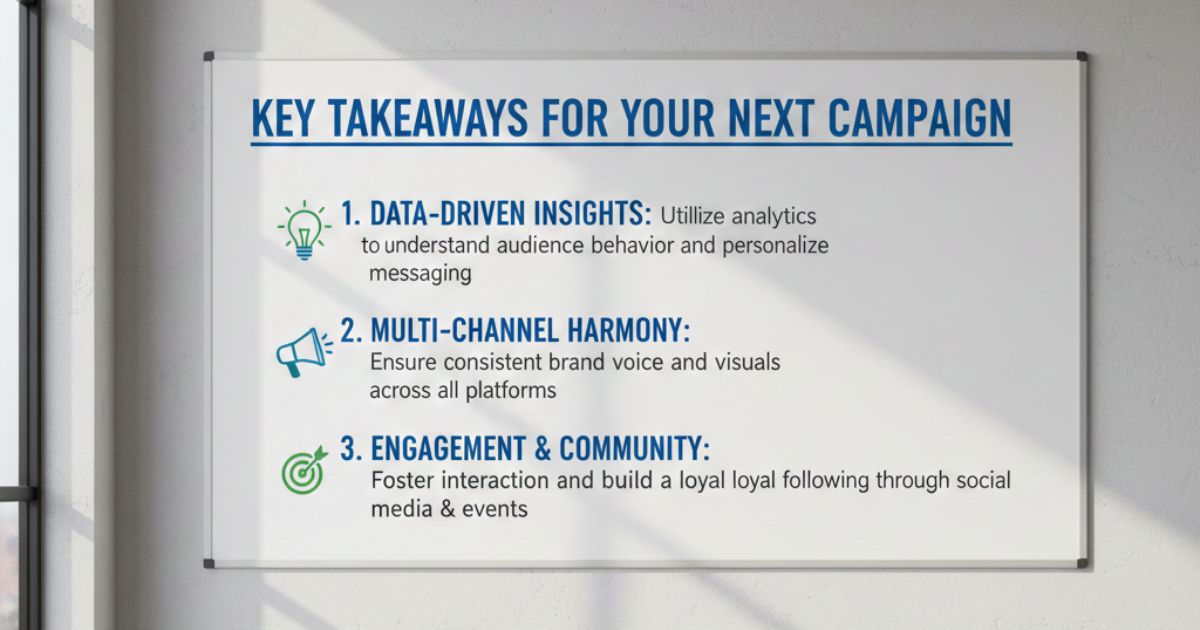
These examples show that the most effective co-marketing campaigns are built on shared audiences, complementary brand values, and a focus on delivering real value to customers. Successful partnerships feel authentic and seamless, not forced or gimmicky.

When planning your own partnership marketing efforts, choose a partner who can help you achieve your goals while you support theirs. Begin by identifying brands that your audience already trusts and engages with. By collaborating on joint marketing initiatives, cross-promotional campaigns, and co-branded content, you can create impactful marketing experiences that resonate with both audiences and drive measurable results.

Conclusion

Co-marketing campaigns are one of the easiest ways for brands to grow. When two companies work together, they share audiences, ideas, and resources. This creates more reach and more trust. Big brands like GoPro, Red Bull, Spotify, HubSpot, and Apple have shown how powerful these partnerships can be.

The key is choosing the right partner. Your partner should have a similar audience, similar values, and the same goals. When both brands promote the campaign together, the results are stronger. Co-branded content, joint promotions, and shared events can help both sides grow faster.

As you plan your next marketing campaign, think about collaboration. Look for a brand your customers already trust. Create simple and useful content together. Build an experience that feels natural for both audiences. With the right partnership, you can reach more people and achieve results that would be hard to get alone.

FAQ

1. What are co-marketing campaigns?

Co-marketing campaigns are partnership marketing initiatives where two or more brands collaborate on joint marketing efforts, share audiences, and promote a common message or offer to achieve mutual benefits.

2. How does co-marketing help my business?

It helps reach new audiences, reduce costs, increase credibility, and generate more leads through shared resources and expertise.

3. How do I choose the right partner?

Look for brands with complementary audiences and values, without being direct competitors, to create authentic and effective campaigns.

4. What types of co-marketing campaigns work best?

Effective campaigns include joint content like ebooks, webinars, events, social media promotions, and immersive digital experiences.

5. How do I measure success?

Measure success with audience reach, engagement rates, leads, conversions, and overall impact on brand awareness.


The Complete Guide to Sponsorship Valuation: How to Price, Measure, and Maximize Deals

0
Sponsorship Valuation

Sponsorship is now an important way for brands to grow. It helps them reach new audiences, build visibility, and improve engagement. Brands use many types of partnerships — like sports sponsorships, influencer deals, events, and digital campaigns. But to invest confidently, they need clear data. This is where Sponsorship Valuation becomes useful.

Sponsorship valuation shows the fair market value of each asset. It also explains the real media value a brand can expect. Many teams use tools like a valuation calculator, industry benchmarks, and insights from valuation companies to make better decisions. Platforms such as SponsorPulse also help with audience data and sentiment.

With proper sponsorship evaluation, brands can measure exposure, track performance through sponsorship monitoring, and estimate true sponsorship ROI. This makes negotiations easier and creates stronger sponsorship deals.

This guide will help you check sponsor ROI, understand brand impact, and get the most value from every partnership opportunity.

What Is Sponsorship Valuation?

Sponsorship valuation is the process of finding the true financial value of a sponsorship opportunity. It helps brands understand what they should pay and helps rights holders know what they should charge. The valuation looks at brand visibility, audience reach, engagement quality, activation ideas, and overall media value.

Modern valuation also uses tools like a valuation calculator, benchmark data from valuation companies, and audience insights from platforms such as SponsorPulse. These help both sides make fair decisions.

A clear and accurate valuation supports better sponsorship evaluation, stronger negotiations, and more profitable sponsorship deals. It also helps brands track performance later through sponsorship monitoring and improves long-term sponsorship ROI.

Why Sponsorship Valuation Matters?

Sponsorship Valuation

Accurate sponsorship valuation is crucial for both brands and rights holders. It ensures fair pricing, stronger negotiations, and better long-term results. Proper valuation also helps measure expected sponsorship ROI and track performance through sponsorship monitoring.

  • It prevents overpricing or underpricing and shows the true market value.
  • It helps brands compare different sponsorship deals using clear data.
  • It gives brands stronger negotiation power.
  • It increases accountability and trust between both parties.
  • It improves overall sponsorship ROI.
  • It gives rights holders data to justify their pricing using tools like a valuation calculator and insights from SponsorPulse.
  • It supports better sponsorship evaluation and ongoing sponsorship monitoring.

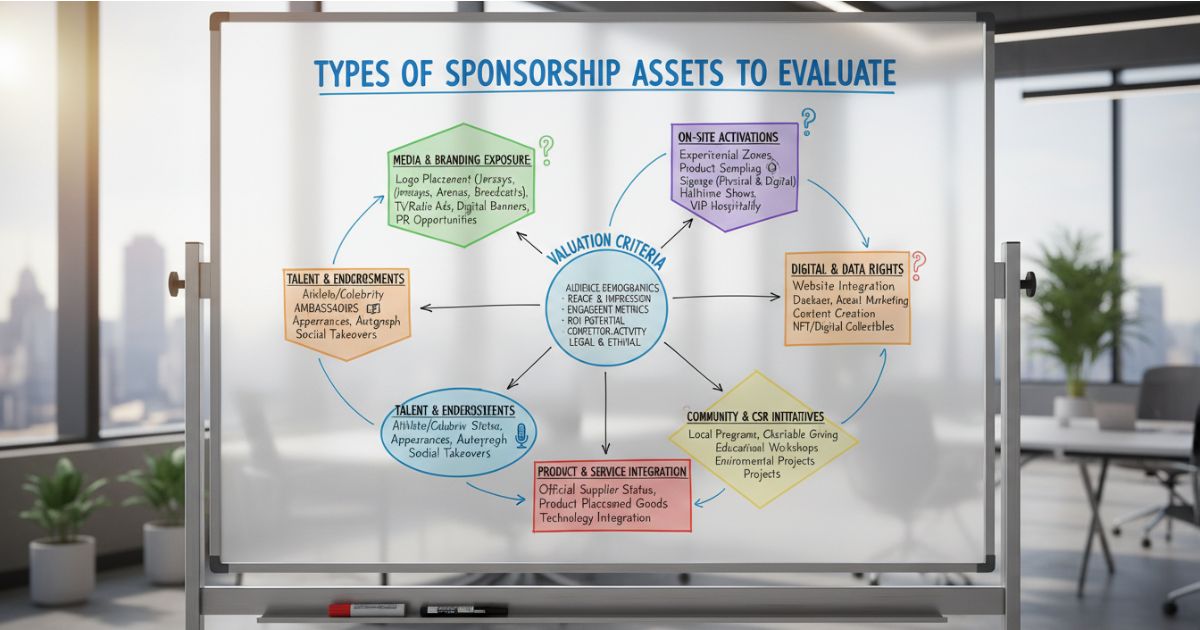
Types of Sponsorship Assets to Evaluate

Types of Sponsorship Assets to Evaluate

Calculating sponsorship valuation helps brands and rights holders understand the true worth of a deal. It measures media value, audience impact, and expected sponsorship ROI. Using a valuation calculator, benchmarking data, and insights from SponsorPulse or valuation companies makes this process more accurate.

Step 1: List All Sponsorship Assets

Make a complete sponsorship inventory including:

  • Branding and visibility assets
  • Digital and social media assets
  • Hospitality and VIP benefits
  • Activation and on-site campaigns
  • Licensing and intellectual property rights

Step 2: Assign Media Value

Estimate media impressions, audience reach, and engagement metrics. Include brand lift and exposure from both on-site and digital channels.

Step 3: Apply Valuation Tools

Use a valuation calculator or reports from valuation companies. Tools like SponsorPulse can provide audience insights, fan passion scores, and competitive benchmarks.

Step 4: Forecast Sponsorship ROI

Calculate expected returns from:

  • Audience engagement and conversions
  • Media impressions and visibility
  • Activation campaign performance

Step 5: Compare with Benchmarks

Use benchmarking reports from similar sponsorship deals in the industry. This ensures the valuation is fair and competitive.

Step 6: Adjust for Activation and Contract Terms

Factor in exclusivity, event timing, or co-branded content opportunities. Review sponsorship agreements for any clauses that affect value.

Proper sponsorship evaluation ensures the final deal reflects true market value, maximizes marketing sponsorship impact, and helps both brands and rights holders track performance through sponsorship monitoring.

How to Conduct a Sponsorship Valuation?

Conduct a Sponsorship Valuation

Step 1: List All Sponsorship Assets

Make a complete inventory of all branding, digital, experiential, and hospitality assets. This helps assign value without missing anything.

Step 2: Review Audience Data

Audience quality directly affects sponsorship pricing.

Evaluate:

  • Audience size
  • Location and demographics
  • Buying behavior
  • Interests
  • Engagement level

Step 3: Calculate Media Value

Media value is one of the biggest parts of sponsorship valuation.

Common valuation methods:

Cost Per Thousand (CPM)

Values impressions and reach.

Advertising Value Equivalency (AVE)

Estimates what equivalent paid media would cost.

Cost Per Engagement (CPE)

Measures engagement and interaction value.

Share of Voice (SOV) analysis

Compares visibility against competitors.

Step 4: Measure Engagement and Activation Potential

Engagement is more valuable than impressions. Strong engagement increases sponsorship ROI.

Look for:

  • Clicks
  • Comments
  • Shares
  • Likes
  • Event participation
  • Lead generation

Step 5: Evaluate Brand Fit

Brand relevance increases sponsorship value. A sponsorship works better when the audience aligns with the sponsor’s niche.

Examples:

  • Tech brands with gaming events
  • Fitness brands with sports events
  • Beauty brands with lifestyle creators

Step 6: Consider Exclusivity and Scarcity

Exclusivity adds premium value. Limited sponsorship categories or exclusive rights increase pricing.

Step 7: Use Industry Benchmarks

Compare your sponsorship assets with:

  • Competitor pricing
  • Market rates
  • Historical sponsorship deals
  • Industry averages

Step 8: Estimate Sponsorship ROI

ROI gives a clear picture of performance and helps forecast future value.

Measure:

  • Media exposure value
  • Social engagement
  • Website traffic
  • Sales impact
  • Brand lift
  • Customer lifetime value

How to Maximize Sponsorship Value?

Maximize Sponsorship Value

Once you have completed the sponsorship valuation, the next step is to ensure that every sponsorship asset delivers maximum impact. Effective strategies help brands and rights holders make the most of their investment while improving audience engagement and brand visibility.

1. Plan Creative Activation Campaigns

Creative activations turn sponsorship assets into meaningful experiences. Well-designed campaigns enhance both media value and audience engagement. Examples include:

  • Contests or giveaways that encourage participation
  • Live events, pop-up experiences, or branded zones
  • Product showcases or interactive demonstrations
  • Influencer collaborations that align with the brand

Activations should connect directly with the target audience and highlight the value of the sponsorship deal.

2. Track and Optimize Performance

Monitoring performance helps refine campaigns in real-time. Brands can measure:

  • Social media engagement and mentions
  • Media impressions across digital and traditional channels
  • Event attendance and participation rates
  • Audience feedback through surveys or focus groups

Using tools like SponsorPulse or a valuation calculator can provide insights into audience interest, helping both brands and rights holders improve sponsorship ROI naturally.

3. Build and Maintain Long-Term Partnerships

Long-term sponsorship agreements often deliver higher value than one-off deals. Benefits include:

  • Improved cost efficiency across multiple campaigns
  • Stronger connections with the target audience
  • More opportunities for activation, content creation, and digital campaigns

Maintaining relationships with event organizers and other rights holders ensures consistent performance and opens doors for future sponsorship opportunities.

4. Enhance Storytelling and Content

Engaging content strengthens the partnership and increases audience impact. Brands should focus on:

  • Behind-the-scenes content from events or campaigns
  • Interviews with athletes, performers, or influencers
  • Case studies demonstrating the impact of the sponsorship
  • Product storytelling that highlights brand values

High-quality content improves brand exposure, supports marketing goals, and enhances the overall media value of the sponsorship.

5. Leverage Digital Platforms and Influencers

Digital channels and carefully selected influencers can amplify sponsorship reach and engagement. This includes:

  • Social media posts, videos, and shoutouts
  • Collaborations with relevant influencers to expand audience reach
  • Branded content and online experiences that complement on-site activations

When executed thoughtfully, digital campaigns and influencer partnerships increase audience reach and strengthen the measurable impact of every sponsorship asset.

By combining creative activation, continuous performance tracking, long-term relationship building, engaging storytelling, and digital amplification, brands can fully maximize the value of their sponsorship deals. This approach ensures measurable results and a higher return from every partnership opportunity while keeping all decisions data-driven and transparent.

Common Mistakes in Sponsorship Valuation

Common Mistakes in Sponsorship Valuation

Even experienced brands and rights holders can make errors when evaluating sponsorship deals. Avoiding these mistakes ensures more accurate sponsorship evaluation and stronger partnerships.

1. Overvaluing or Undervaluing Assets

Assigning too much or too little media value to branding, digital, or activation assets can lead to unfair deals. Always use a valuation calculator or benchmark data from valuation companies.

2. Ignoring Audience Fit

Focusing only on visibility without considering audience demographics or engagement reduces the effectiveness of a sponsorship. Tools like SponsorPulse can provide insights into audience interest and behavior.

3. Relying on Outdated Metrics

Using old data for reach, impressions, or engagement may misrepresent actual value. Always track performance through sponsorship monitoring.

4. Skipping Activation Value

Some valuations ignore on-site or digital activations, contests, or influencer campaigns. These can significantly boost the overall sponsorship ROI.

5. Neglecting Long-Term Potential

Short-term thinking may overlook opportunities for repeat partnerships, cumulative brand lift, or future co-branded campaigns.

6. Blindly Copying Competitor Pricing

Every sponsorship deal is unique. Copying pricing from other deals without considering assets, audience, and media exposure can cause mispricing.

By avoiding these mistakes, brands and rights holders can make data-driven decisions, improve negotiation confidence, and maximize the return on every marketing sponsorship.

Conclusion

Understanding sponsorship valuation helps brands and rights holders make fair, data-driven decisions. Accurate valuation shows the real worth of every asset and supports clear sponsorship deals. Tools like valuation calculators and insights from SponsorPulse or valuation companies make this process easier.

In today’s sponsorship marketing paradigm shift, combining creative campaigns, digital activations, and influencer collaborations increases media value and audience engagement. Long-term planning and sponsorship monitoring help track performance and improve future partnerships.

By balancing data, creativity, and strategic planning, brands can maximize the impact of their marketing sponsorships while keeping deals profitable and sustainable.

FAQ

1. What does sponsorship valuation mean?

It means calculating the real financial value of a sponsorship asset using media value, engagement, and audience data.

2. What factors affect sponsorship pricing?

Audience size, brand alignment, digital exposure, media value, exclusivity, and activation opportunities.

3. How do you measure sponsorship ROI?

Through media impressions, engagement metrics, leads, conversions, brand lift, and long-term revenue impact.

4. What tools help with sponsorship valuation?

Media measurement tools, social analytics platforms, valuation software, audience insight tools, and benchmark databases.

5. Why is audience engagement important for sponsorship value?

High engagement means the audience is paying attention, which increases brand impact and partnership ROI.

The ROI of Multi-Brand Collaboration Campaigns: Metrics You Need

0
Multi-Brand Collaboration

Brand collaborations are everywhere today. Major partnerships—like Barbie × Zara, Taco Bell × Doritos, Adidas × Gucci, and Spotify × Starbucks—show how powerful co-branded marketing can be. These collaborations create excitement, boost visibility, and spark conversations across social media. But beyond the hype, one question remains: Are these campaigns truly delivering a strong ROI?

Many brands launch partnership campaigns without a clear way to measure impact. It’s easy to notice a jump in followers, website traffic, or short-term sales. But to understand the real value of a multi-brand collaboration, you need to track deeper metrics that reveal long-term performance, financial return, and customer behavior.

This guide will walk you through the key metrics, performance indicators, and analytics frameworks you need to evaluate collaboration ROI. You’ll learn how to measure brand lift, shared audience growth, earned media value, customer acquisition cost, and revenue impact—all essential for proving the success of your partnership marketing strategy.

By the end, you’ll have a clear, actionable framework to measure results, optimize future co-branded campaigns, and make smarter, data-driven decisions that drive growth for both brands.

Why Tracking Collaboration Campaign Metrics is Crucial?

Multi-Brand Collaboration ROI

Measuring your collaboration campaign performance is essential if you want to understand what is working and what is not. Before the campaign begins, both brands should define what success means. Do you want to increase brand awareness, drive product sales, grow your email list, boost website traffic, or reach a new customer segment? Clear, shared goals create a benchmark for measuring true partnership ROI.

Tracking the right metrics does more than prove that your collaboration was worth the investment. It shows you which channels performed best, which messages connected with your joint audience, and which content formats drove engagement. These insights help you improve future co-branding strategies, optimize cross-promotional efforts, and build stronger long-term partnerships.

Without data, you’re guessing. You may see a spike in likes or followers, but you won’t know what actually caused it or whether it delivered real business value. Metrics turn assumptions into clear evidence, helping both brands make smarter, data-backed decisions for every future collaboration.

Key Metrics for Measuring Partnership Success

To accurately assess the ROI of your multi-brand collaboration, you need a well-rounded metrics framework that covers brand awareness, audience engagement, lead generation, and revenue impact. These data points help you understand not only how visible your campaign is, but how effectively it converts attention into business growth.

Brand Awareness Metrics

These metrics reveal whether your collaboration successfully expanded visibility and introduced your brand to new audiences.

1. Website Traffic

  • Track total sessions and traffic spikes throughout the campaign period.
  • Use UTM parameters to identify which partner channels (email, social posts, website banners, influencer mentions) drove the highest-quality traffic.

Understanding the top-performing touchpoints helps you optimize future partnership executions.

2. Social Media Reach & Impressions

Measure how many unique users saw your collaborative content (reach) and how many total times it appeared across feeds (impressions).
A strong lift here indicates effective cross-promotion and expanded brand exposure through your partner’s audience.

3. Brand Mentions & Share of Voice

Use social listening tools to analyze campaign-related mentions, sentiment, and conversation volume.
Compare your share of voice to competitors to determine whether the collaboration boosted your market visibility and drove brand-level conversation.

Engagement Metrics

Engagement showcases how actively your new audience is interacting with your content—not just seeing it.

1. Likes, Comments & Shares

These direct engagement signals reveal how relevant, relatable, and compelling your content is to both audiences.
High engagement rates often correlate with stronger campaign resonance and better organic distribution.

2. Click-Through Rate (CTR)

CTR measures how many users clicked on your email, ad, or social call-to-action.
A strong CTR is a reliable indicator that your messaging, visuals, and value proposition are effective.

3. Time on Page & Bounce Rate

Once users land on your website or campaign landing page, evaluate how long they stay and how many explore additional pages.

  • High time on page = strong content relevance
  • Low bounce rate = effective user experience and message alignment

Both indicate that your collaborative content is delivering value.

Lead Generation & Sales Metrics

These metrics connect your collaboration directly to pipeline growth and revenue impact.

1. Leads Generated

Track new contacts acquired through webinar sign-ups, gated downloads, co-branded content offers, or exclusive campaign landing pages.
This helps you evaluate how effectively the collaboration expanded your potential customer base.

2. Conversion Rate

Measure the percentage of visitors or leads that completed a desired action—such as a purchase, demo request, or free trial.
High conversion rates demonstrate strong alignment between the partnership offer and audience needs.

3. Customer Acquisition Cost (CAC)

Divide total campaign spend by the number of new customers acquired.
Comparing collaboration CAC with your standard CAC helps you determine if the partnership model is cost-efficient.

4. Sales Revenue

Use unique discount codes, partner landing pages, or attribution models to tie revenue directly to the collaboration.
This gives you a clear picture of both short-term sales impact and long-term value driven by the partnership.

Collaboration ROI

Once you’ve compiled all the performance data from your collaboration campaign, the next step is calculating its Return on Investment (ROI). ROI helps you understand the true financial impact of your partnership—not just in terms of engagement, but actual business growth.

The Basic ROI Formula

ROI (%) = (Net Profit / Total Investment) × 100

This formula gives you a clear percentage that reflects whether your collaboration generated measurable value.

How to Calculate Collaboration ROI

1. Calculate Net Profit

Start by determining the total revenue generated from the campaign.
This may include:

  • Direct sales attributed to the collaboration
  • Revenue tracked via discount codes or partner landing pages
  • Estimated lifetime value (LTV) of new customers acquired through the campaign

Then subtract the total campaign cost to determine net profit.

2. Determine Total Investment

Combine all expenses associated with running the collaboration:

  • Partnership fees or co-marketing contributions
  • Paid advertising and media spend
  • Content creation costs (videos, design, copywriting, etc.)
  • Costs of promotional incentives (discounts, freebies, bundles)

This gives you a complete picture of your total financial input.

3. Apply the ROI Formula

Insert your net profit and investment into the ROI formula to calculate your final ROI percentage.
A positive ROI shows your partnership generated profit, while a negative one indicates you spent more than you earned.

ROI Example

If your multi-brand campaign generated $20,000 in revenue and cost $5,000 to run:

  • Net Profit: $20,000 – $5,000 = $15,000
  • ROI: ($15,000 ÷ $5,000) × 100 = 300% ROI

This means the collaboration returned three times the amount you invested.

Unlock Your Partnership Potential

Multi-Brand Collaboration

Measuring the ROI of multi-brand collaboration is not just about numbers; it’s about gaining strategic clarity and insight. By diligently tracking the right metrics, you can move beyond assumptions and truly understand the impact of your partnerships. This data-driven approach allows you to optimize your strategies, strengthen relationships with your partners, and consistently drive meaningful growth for your brand. Sponsorships enhance relationship marketing, creating deeper connections and mutual value between collaborating brands.

Start by defining your goals, setting up your tracking systems, and committing to analyzing the results. The insights you gain will be instrumental in building more effective and profitable collaborations in the future.

Conclsuion

Measuring the ROI of a multi-brand collaboration is important. It helps you understand what your partnership achieved and how it supported your business goals. When you track key metrics like brand awareness, engagement, leads, conversions, and revenue, you get a full picture of your campaign’s performance.

Simple data points—such as website traffic, CTR, and sales—show what worked well and what needs improvement. This makes your future co-branded campaigns stronger and more cost-effective. It also helps both brands build trust, improve teamwork, and create better partnership strategies.

By using clear goals, accurate tracking, and basic analytics, you can see the real value of your collaboration. This approach supports long-term growth, better audience reach, and stronger brand relationships. With consistent measurement and optimization, your collaborations will deliver meaningful ROI and long-lasting results.

FAQs

1. What is a multi-brand collaboration campaign?

A multi-brand collaboration campaign is a marketing partnership where two or more brands work together to create co-branded products, content, or promotions. The goal is to reach new audiences, boost brand visibility, and drive shared business growth.

2. Why is it important to measure collaboration campaign ROI?

Measuring ROI helps brands understand whether their partnership generated meaningful value. Without tracking metrics, it’s impossible to know if the campaign increased awareness, engagement, leads, or revenue—and whether the investment was worth it.

3. What metrics should I track in a brand collaboration campaign?

Key metrics include website traffic, social media reach, impressions, engagement rate, CTR, leads generated, conversion rate, customer acquisition cost (CAC), sales revenue, and share of voice.

4. How do I track traffic from my collaboration partner?

Use UTM parameters on all links shared by your partner. This helps you see exactly which channels—email, social media, website banners, influencer posts—drove the most traffic and conversions.

5. How do I measure brand awareness in a collaboration campaign?

Track metrics such as social reach, impressions, branded searches, website sessions, share of voice, and campaign-related brand mentions to understand how far your collaboration message traveled.

6. What is share of voice in partnership marketing?

Share of voice (SOV) measures how often your brand is mentioned online versus your competitors. In collaboration campaigns, it helps indicate whether your partnership increased your influence and visibility in the market.

7. What is the best way to measure engagement in co-branded campaigns?

Engagement metrics include likes, comments, shares, click-through rates (CTR), time on page, and content interactions. These show whether the audience found your co-branded content meaningful and relevant.

Partnership Marketing Trends Dominating Digital Ads

0
Partnership Marketing Trends

Digital advertising is changing fast. People now prefer honest and real content, so traditional ads don’t work as well as before. This is why partnership marketing is growing. It helps brands team up with influencers, creators, affiliates, and other companies to build trust and reach new audiences.

Partnership marketing includes influencer posts on Instagram and TikTok, affiliate programs, creator-led videos on YouTube, and simple brand-to-brand collaborations. It also uses AI tools to make campaigns smarter and more effective. These methods help brands get better results and improve engagement across digital platforms.

Knowing the latest partnership marketing trends is important for staying competitive. Trends like AI-driven personalization, creator partnerships, and stronger affiliate networks are shaping the future of digital ads. This guide will help you understand these changes and use them in your own marketing strategy.

What is Partnership Marketing?

Partnership Marketing

Partnership marketing is a strategy where two or more businesses team up to promote each other in a mutually beneficial way. It often includes affiliate marketing, influencer partnerships, co-branded campaigns, creator collaborations, and joint loyalty programs. Each partner brings its own audience, strengths, and resources to the table.

The main goal is to reach new customers, build trust faster, and increase brand visibility without relying only on traditional ads. By sharing audiences and combining marketing efforts, brands can reduce costs, improve credibility, and drive more sales. Partnership marketing works well across digital platforms like social media, email, websites, and e-commerce because it feels more authentic and community-driven.

5 Partnership Marketing Trends to Watch

5 Partnership Marketing Trends

The world of digital advertising is dynamic, and partnership marketing is evolving with it. Here are the most significant trends poised to dominate the industry.

1. The Rise of AI and Automation

Artificial intelligence is no longer a futuristic concept; it’s a practical tool revolutionizing partnership marketing. AI-powered platforms are making it easier than ever to discover, recruit, and manage partners. These tools can analyze vast amounts of data to identify the most suitable partners for your brand, predicting their potential impact and ensuring a better fit.

How it’s changing the game:

  • Efficient Partner Discovery: AI algorithms can sift through thousands of potential influencers, affiliates, and brand partners to identify those that align perfectly with your brand values and target audience.
  • Automated Management: Tasks like tracking performance, processing payments, and communicating with partners can be automated, freeing up time for more strategic activities.
  • Predictive Analytics: AI can forecast the ROI of potential partnerships, helping you make smarter, data-driven decisions.

2. The Creator Economy Takes Center Stage

The creator economy has exploded, and influencers are now a central part of many brands’ marketing strategies. This trend is moving beyond simple sponsored posts. Today, it’s about building long-term, authentic relationships with creators who genuinely love and use your products. These creators act as brand ambassadors, producing content that feels natural and resonates deeply with their followers.

What to focus on:

  • Long-Term Relationships: Instead of one-off campaigns, invest in ongoing collaborations with creators who align with your brand.
  • Authentic Content: Give creators the freedom to produce content in their own voice. Their audience follows them for their unique perspective, and authenticity drives engagement.
  • Micro- and Nano-Influencers: While mega-influencers have a broad reach, smaller creators often boast higher engagement rates and a more dedicated following within niche markets.

3. Data-Driven Partnership Strategies

Gut feelings are no longer enough to guide marketing decisions. Today, successful partnership marketing relies on robust data and analytics. By tracking key performance indicators (KPIs) such as conversion rates, customer lifetime value (CLV), and engagement, you can accurately measure the true impact of your partnerships. This data-driven approach allows you to optimize your campaigns, reallocate your budget to high-performing partners, and prove the ROI of your efforts.

Key metrics to track:

  • Conversion Rate: The percentage of users who complete a desired action, such as making a purchase or signing up for a newsletter.
  • Customer Acquisition Cost (CAC): The total cost of acquiring a new customer through a specific partner.
  • Return on Investment (ROI): The overall profitability of your partnership campaigns.

4. Affiliate Marketing Diversification

Affiliate marketing has been a cornerstone of partnership marketing for years, but it’s evolving. The trend is moving away from a heavy reliance on coupon and deal sites. Brands are now diversifying their affiliate programs to include content creators, media publications, and even B2B partners. This diversification helps reach new audiences and builds a more resilient and effective affiliate strategy.

Emerging affiliate channels:

  • Content Creators: Bloggers, YouTubers, and podcasters who create in-depth reviews and tutorials featuring your products.
  • Review Sites: Trusted third-party sites that provide unbiased reviews and comparisons.
  • B2B Partnerships: Collaborating with other businesses that serve a similar audience but are not direct competitors.

5. Co-Branding and Content Collaborations

Two heads are often better than one, especially when it comes to content. Co-branded marketing campaigns allow two non-competing brands to pool their resources and creativity to produce valuable content for a shared audience. This can include anything from joint webinars and ebooks to co-hosted events and podcasts. These collaborations can significantly expand your reach and lend credibility to your brand.

Examples of effective co-branding:

  • GoPro and Red Bull: These two brands have formed a powerful partnership centered on high-energy action sports, producing co-branded content that appeals to both their audiences.
  • Spotify and Starbucks: Their collaboration allows Starbucks customers to discover music playing in-store and save it to their Spotify playlists, creating a seamless brand experience.

Get Ahead with Smarter Partnerships

Partnership Marketing Trends

Digital advertising is becoming more collaborative. Brands now need strong partnerships to stay competitive. Partnership marketing is no longer just a single channel. It is becoming an important part of overall growth for many companies.

Brands can grow faster by using AI tools, working closely with creators, and making decisions based on real data. These steps help improve targeting, increase trust, and reach the right audience at the right time. A diverse partner network also brings more stability and reduces risk.

The trends in this guide show how partnership marketing is changing. Now is the right time to review your current strategy. Look for new partners, new platforms, and new ways to collaborate. Adding smarter partnerships to your marketing mix will help you grow in a steady and sustainable way.

Conclusion

Partnership marketing is evolving fast, and brands that adapt will grow the most. Today’s digital landscape rewards collaborative marketing, authentic content, and smart use of technology. By using AI tools, building strong influencer collaborations, and focusing on performance-driven campaigns, businesses can reach the right audience more effectively.

The trends in this guide show how digital partnerships are shaping the future of advertising. With better data, stronger creator relationships, and a more omnichannel strategy, brands can improve trust and increase long-term growth. Now is the best time to review your current approach, explore new partnership opportunities, and invest in smarter, more flexible marketing methods.

Strong partnerships lead to stronger results—and this simple strategy can help any business stand out in a crowded digital world.

Frequently Asked Questions

What is the most important partnership marketing trend?

While all the trends mentioned are significant, the integration of AI and automation is arguably the most transformative. It underpins many other trends by providing the tools to execute more sophisticated, data-driven, and scalable partnership strategies.

How can a small business leverage these partnership marketing trends?

Small businesses can start by focusing on micro-influencers and local partnerships to build their brand. These collaborations are often more affordable and can yield high engagement within a niche audience. Using accessible AI tools for partner discovery and focusing on creating authentic, co-branded content can also provide a competitive edge without a massive budget.

How do you measure the success of partnership marketing?

Success is measured using a variety of KPIs relevant to your goals. Key metrics include traffic, conversion rates, customer acquisition cost (CAC), return on ad spend (ROAS), and customer lifetime value (CLV). It’s crucial to use tracking software to attribute results accurately to specific partners.

Why is authenticity so important in partnership marketing?

Modern consumers are wary of traditional advertising and can easily spot inauthentic endorsements. Authenticity builds trust. When a partner genuinely believes in a product, their recommendation carries more weight, leading to higher engagement and more meaningful conversions.

What are the key benefits of partnership marketing for brands today?

Partnership marketing helps brands reach new audiences, build trust faster, and reduce advertising costs. It also improves credibility because recommendations come from trusted partners like creators, affiliates, or other brands.

How do I choose the right partners for my marketing campaign?

Choose partners who share your target audience, brand values, and content style. Look at their engagement rates, past collaborations, and how well their audience matches your ideal customer.

What is the difference between affiliate marketing and partnership marketing?

Affiliate marketing is performance-based and focuses on commissions for each sale or lead. Partnership marketing is broader. It includes affiliates, creators, co-branding, influencer campaigns, and brand collaborations.

How does AI improve partnership marketing strategies?

AI helps brands find better partners, predict campaign results, and automate tasks like tracking performance and managing payouts. It also improves targeting and personalization.

Which industries see the best results from partnership marketing?

Industries like e-commerce, fashion, beauty, SaaS, travel, and fitness get strong results because their audiences respond well to creator content, reviews, and product recommendations.

How Micro-Influencer Partnerships Are Changing Brand Marketing

0
Micro-Influencer Partnerships

The marketing landscape has shifted dramatically. While celebrities with millions of followers once dominated brand partnerships, a new player has emerged that’s proving more effective and affordable: micro-influencers.

These content creators, typically with 1,000 to 100,000 followers, are reshaping how brands approach influencer collaboration. Their smaller but highly engaged audiences are driving better results than traditional celebrity endorsements, creating authentic connections that consumers actually trust.

This transformation isn’t just a passing trend. Micro-influencer partnerships are fundamentally changing brand marketing strategies, offering companies new ways to reach targeted audiences with authentic messaging that resonates.

What Makes Micro-Influencers Different

What Makes Micro-Influencers Different

Micro-influencers occupy a unique space between everyday social media users and celebrity influencers. They’ve built dedicated communities around specific niches—whether that’s sustainable fashion, local food scenes, or fitness routines for busy parents.

Unlike macro-influencers who often work with dozens of brands, micro-influencers are more selective about their partnerships. This selectivity translates into more authentic recommendations that genuinely resonate with their followers.

Their content feels personal and relatable. When a micro-influencer shares their morning skincare routine or reviews a new restaurant, it comes across as a friend’s recommendation rather than a paid advertisement. This authenticity is what makes their partnerships so valuable for brands.

The Trust Factor: Why Audiences Respond Better

The Trust Factor: Why Audiences Respond Better

Trust is the foundation of effective influencer marketing, and micro-influencers excel at building it. Their followers often feel like they know them personally, creating a level of trust that’s difficult for larger influencers to achieve.

Research consistently shows that engagement rates decrease as follower counts increase. Micro-influencers typically see engagement rates between 2% and 5%, significantly higher than macro-influencers, who often struggle to achieve engagement rates of 1% to 2%.

This higher engagement stems from genuine relationships. Micro-influencers respond to comments, remember their followers’ names, and create content that directly addresses the interests and concerns of their community. When they recommend a product, their audience listens because they’ve built credibility over time.

Cost-Effectiveness That’s Hard to Ignore

Cost-Effectiveness That's Hard to Ignore

Budget constraints often limit brand marketing efforts, making micro-influencer collaboration an attractive option. While a single celebrity post might cost tens of thousands of dollars, brands can partner with multiple micro-influencers for the same budget.

This approach offers several advantages:

  • Diversified reach: Working with multiple micro-influencers allows brands to tap into various niche communities
  • Reduced risk: If one partnership doesn’t perform well, others can compensate
  • Testing opportunities: Brands can experiment with different messaging and content styles across partnerships

The return on investment often exceeds expectations. Micro-influencers’ authentic recommendations typically drive higher conversion rates than traditional advertising, making them a cost-effective marketing channel.

Targeting Niche Audiences with Precision

Micro-influencers excel at reaching specific demographic groups and interest categories. A sustainable fashion brand can partner with eco-conscious lifestyle influencers, while a local restaurant might work with food bloggers in their city.

This precision targeting eliminates waste in marketing spend. Instead of paying for broad reach where most viewers aren’t interested in the product, brands can focus their budgets on audiences already interested in their category.

Geographic targeting also becomes more manageable. Local micro-influencers can help businesses connect with customers in specific markets, making them particularly valuable for restaurants, retail stores, and service businesses.

The Content Creation Advantage

The Content Creation Advantage

Micro-influencer partnerships offer brands high-quality, authentic content that can be repurposed across various marketing channels. This user-generated content often performs better than traditional brand-created content because it feels more genuine.

The content creation process with micro-influencers tends to be more collaborative and flexible. They understand their audience’s preferences and can adapt brand messaging to fit their community’s communication style and interests.

Brands also benefit from the diverse content formats micro-influencers create. From Instagram Stories and Reels to blog posts and YouTube videos, these partnerships generate multiple pieces of content from a single collaboration.

Building Long-Term Brand Relationships

The most successful micro-influencer partnerships extend beyond single-post collaborations. Brands are increasingly focusing on building long-term relationships with micro-influencers who genuinely use and love their products.

These ongoing partnerships offer several benefits:

  • Consistent brand presence: Regular mentions keep the brand visible to the influencer’s audience
  • Authentic product integration: Long-term partners naturally incorporate products into their content
  • Deeper audience connection: Repeated exposure helps build brand recognition and trust

Long-term relationships also allow both parties to optimize their collaboration over time, learning what content resonates best with the audience and drives the strongest results.

Measuring Success in Micro-Influencer Campaigns

Effective measurement goes beyond follower counts and likes. Brands working with micro-influencers focus on metrics that indicate genuine engagement and business impact.

Key performance indicators include:

  • Engagement rate: Comments, shares, and saves indicate audience interest
  • Click-through rates: Traffic to brand websites or landing pages
  • Conversion rates: Actual purchases or sign-ups generated from the partnership
  • Brand mention sentiment: The tone and context of audience discussions about the brand

These metrics provide a clearer picture of campaign effectiveness than vanity metrics, such as reach or impressions, alone.

Common Challenges and Solutions

While micro-influencer partnerships offer many advantages, they also present unique challenges. Managing multiple smaller partnerships requires more coordination than working with a single celebrity influencer.

Quality control can also be more complex. With numerous content creators involved, maintaining consistent brand messaging while allowing authentic expression requires clear guidelines and regular communication.

Many brands address these challenges by:

  • Using influencer management platforms: These tools streamline communication and campaign tracking
  • Developing clear brand guidelines: Providing influencers with specific dos and don’ts while maintaining creative freedom
  • Starting small: Testing partnerships with a few micro-influencers before scaling up

The Future of Authentic Brand Marketing

The Future of Authentic Brand Marketing

Micro-influencer partnerships represent more than a marketing tactic—they signal a fundamental shift toward authentic, community-driven brand building. As consumers become increasingly skeptical of traditional advertising, these genuine relationships offer brands a way to connect meaningfully with their audiences.

The success of micro-influencer collaboration lies in its human element. These partnerships work because they’re built on real relationships and genuine product experiences, creating marketing that doesn’t feel like marketing.

For brands ready to embrace this approach, the opportunity is significant. Start by identifying micro-influencers whose values align with yours. Focus on building genuine relationships and measure success through meaningful engagement, rather than vanity metrics. The brands that master micro-influencer partnerships now will have a significant advantage as this marketing approach continues to evolve.

Strategic Collaboration in Modern Branding

Modern brands are increasingly focusing on collaboration-driven growth rather than one-sided promotions. This is where Partnership Marketing becomes a powerful strategy. By collaborating with creators, platforms, or complementary brands, companies can expand reach while maintaining authenticity. Partnership Marketing works best when both sides share common values and audience interests. Instead of pushing aggressive ads, brands co-create content that feels organic and valuable. This approach helps build long-term credibility rather than short-term visibility. With social media-driven consumer behavior, partnerships now play a major role in brand storytelling, community building, and trust creation. Businesses that invest in partnership-based strategies often see better engagement, stronger brand recall, and sustainable audience growth over time.

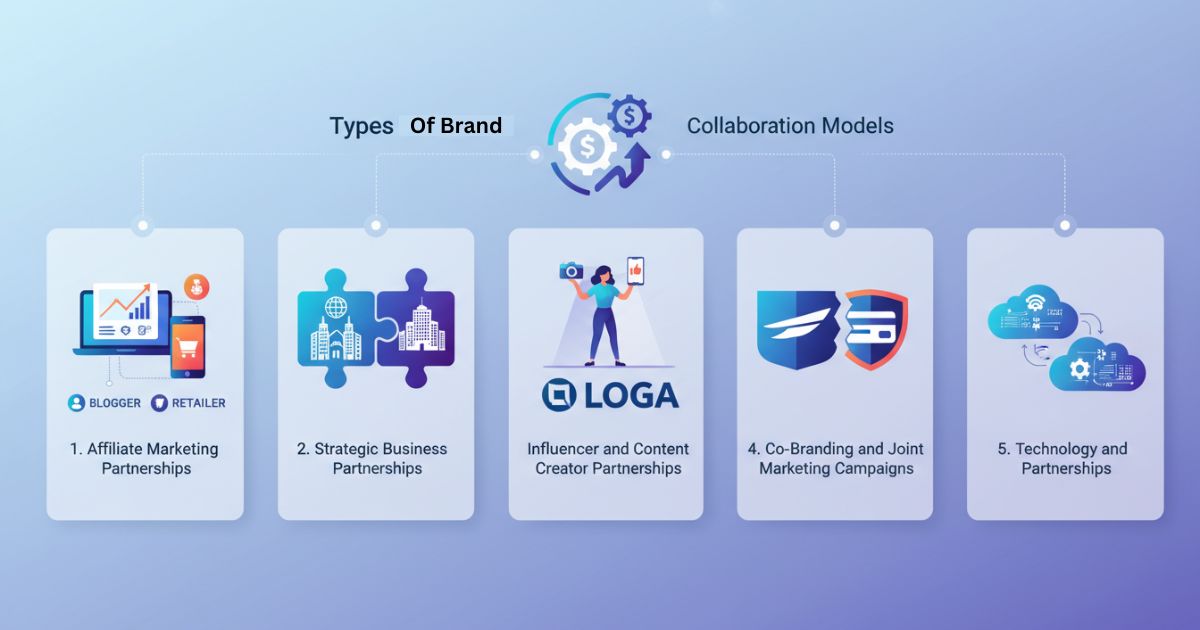
Understanding Collaboration Models in Influencer Campaigns

When brands explore collaborations, confusion often arises around Influencer vs Brand Partnership models. Influencer partnerships usually focus on content creation and promotion, while brand partnerships involve deeper collaboration, shared campaigns, and mutual branding. Influencer vs Brand Partnership decisions depend on campaign goals, budget, and target audience. Influencer-driven efforts are great for quick reach and engagement, whereas brand partnerships work better for long-term positioning. Understanding this distinction helps businesses choose the right collaboration structure. Brands that align the partnership type with their objectives tend to achieve higher ROI and clearer messaging. Selecting the wrong model can dilute impact, making strategic clarity essential.

Executing Collaborative Campaigns for Growth

A well-planned Partner Marketing Campaign can significantly amplify brand visibility and credibility. These campaigns focus on shared goals, combined audiences, and co-branded messaging. A Partner Marketing Campaign often includes collaborative content, joint promotions, and cross-platform exposure. Success depends on alignment between partners, transparency, and consistent communication. Brands that treat partner campaigns as long-term relationships rather than one-off promotions often achieve better results. Clear KPIs, audience targeting, and performance tracking are essential to maximize campaign impact. When executed properly, partner-driven campaigns not only increase reach but also strengthen brand trust and customer loyalty.

Growth Opportunities for Smaller Brands

Influencer Marketing For Small Businesses has become one of the most effective growth tools in today’s digital ecosystem. Small businesses often lack large advertising budgets, making micro and nano influencers an ideal choice. Influencer Marketing For Small Businesses allows targeted outreach, local visibility, and authentic storytelling. These collaborations feel more personal and relatable, which resonates strongly with niche audiences. By focusing on engagement rather than reach, small brands can drive conversions without overspending. This approach also enables testing different messages and audiences before scaling. For startups and local brands, influencer partnerships provide measurable growth with controlled investment.

Industry Insights and Market Research

Data-driven insights play a crucial role in shaping modern marketing decisions. Industry reports, consumer behavior studies, and digital marketing trends help brands understand what works and what doesn’t. This type of content is ideal for referencing external research blogs, marketing publications, and analytics-focused articles. Brands that rely on verified data can optimize strategies, predict trends, and avoid costly mistakes. Linking to authoritative studies strengthens content credibility and supports informed decision-making. External research-backed insights also help readers gain deeper understanding beyond surface-level marketing tactics.

Case Studies and Real-World Examples

Real-world case studies provide practical proof of marketing strategies in action. By analyzing successful brand collaborations, influencer campaigns, and partnership models, readers gain actionable insights. These sections are perfect for linking to detailed case studies, brand stories, or marketing analysis blogs. Case-driven learning helps businesses visualize outcomes, challenges, and best practices. External examples increase trust and allow readers to explore deeper success stories independently. Well-documented case studies bridge the gap between theory and real execution.

Trends Shaping the Future of Collaborative Marketing

Marketing trends evolve rapidly, influenced by platform changes, audience behavior, and technology. Topics like creator economies, community-led branding, and ethical collaborations are shaping the future. Trend-focused sections allow you to connect your content with external thought leadership blogs, marketing trend reports, and expert opinions. Keeping an eye on emerging patterns helps brands stay competitive and relevant. External trend analysis adds authority and future-focused value to your content, encouraging readers to explore updated insights beyond your blog.

Learn More: Influencer vs Brand Partnerships

Frequently Asked Questions (FAQ)

What is a micro-influencer in brand marketing?

A micro-influencer is a content creator who typically has between 1,000 and 100,000 followers and focuses on a specific niche. In brand marketing, micro-influencers are valued for their high engagement rates, authentic content, and strong trust with their audience, making them more effective than large celebrity influencers in many campaigns.

Why are micro-influencer partnerships more effective than celebrity endorsements?

Micro-influencer partnerships feel more authentic because their content is personal and relatable. Audiences trust their recommendations more, leading to higher engagement and conversion rates compared to celebrity endorsements, which often feel overly promotional.

How do micro-influencers help brands reach niche audiences?

Micro-influencers build communities around specific interests like fitness, sustainability, food, or local lifestyles. Brands can partner with relevant micro-influencers to target highly specific audiences, ensuring marketing messages reach people who are already interested in the product category.

Are micro-influencer campaigns cost-effective for small businesses?

Yes, micro-influencer campaigns are highly cost-effective. Small businesses can work with multiple micro-influencers at a lower cost than a single macro-influencer, allowing better budget control, diversified reach, and higher return on investment.

What platforms work best for micro-influencer marketing?

Instagram, TikTok, YouTube, and LinkedIn are the most popular platforms for micro-influencer marketing. Instagram and TikTok work well for lifestyle and consumer brands, while LinkedIn is ideal for B2B micro-influencer partnerships.

How can brands measure the success of micro-influencer partnerships?

Success is measured using engagement rate, click-through rate, conversions, audience sentiment, and content saves or shares. These metrics provide better insight into campaign performance than follower count alone.

What are the biggest challenges in working with micro-influencers?

Managing multiple influencers, maintaining brand consistency, and tracking performance can be challenging. Brands often solve this by using influencer management tools, setting clear guidelines, and building long-term relationships instead of one-time collaborations.

Is micro-influencer marketing a long-term strategy?

Yes, micro-influencer marketing is a long-term strategy focused on trust, authenticity, and community building. As consumers continue to value genuine recommendations over ads, micro-influencer partnerships will remain a key part of brand marketing strategies.

15 Game-Changing Sponsorship Activation Ideas That Actually Work

0
Sponsorship Activation Ideas

When Red Bull supported Felix Baumgartner’s jump from the edge of space, the world watched. Millions saw him break the sound barrier in real time. This moment showed how powerful a strong sponsorship activation can be. It also reinforced Red Bull’s identity as a bold and high-energy brand.

Today, sponsorship is more than placing a logo on a screen or banner. Audiences expect real value. They want experiences, stories, and emotional moments. Modern sponsorship activation ideas focus on creativity, authenticity, and genuine engagement. Brands that use smart activation strategies gain more than visibility. They build trust, loyalty, and long-term customer relationships.

This guide shares 15 sponsorship activation ideas that work in real life. You can use these ideas for sports sponsorships, event marketing, brand partnerships, influencer collaborations, and digital campaigns. Each idea is designed to improve ROI, boost engagement, and help your brand stand out in a competitive market.

What Makes Sponsorship Activation Successful?

Successful sponsorship activation is more than traditional advertising. While old-style marketing pushes messages at people, smart brand sponsorship activation invites audiences to take part. It creates real experiences that feel personal and meaningful.

Strong corporate sponsorship ideas share a few clear traits. They match the brand’s values. They speak directly to the target audience. And they deliver value for both the brand and the partner. The best activations also use multiple touchpoints—such as social media, live events, mobile apps, or digital content—to extend the impact long after the main moment is over.

Modern sponsorship techniques use technology, social engagement, and experiential marketing to build deeper connections. These strategies work because today’s consumers want authenticity. They want useful experiences, not passive ads. When brands deliver this, sponsorship activation becomes more powerful, more memorable, and more effective.

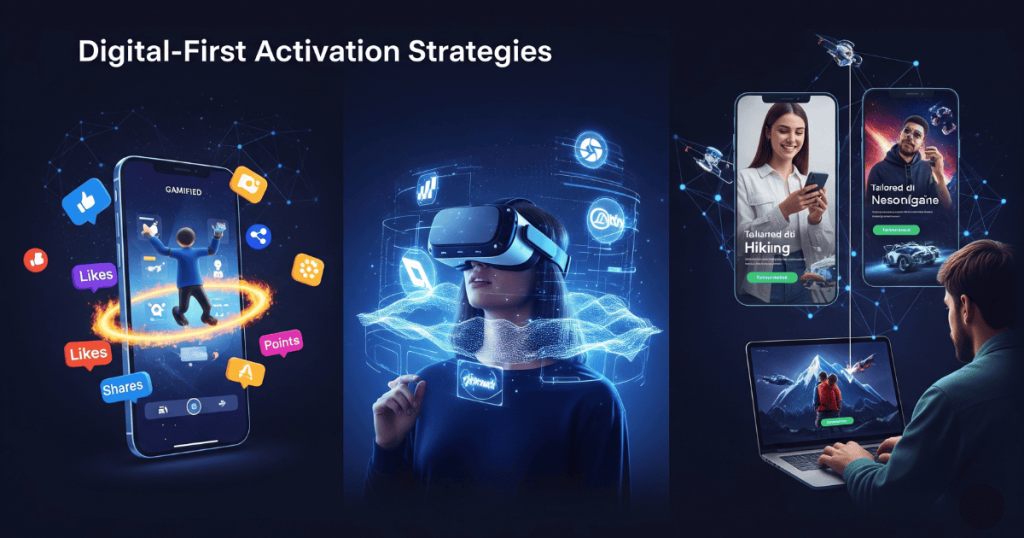
Digital-First Activation Strategies

Sponsorship Activation Ideas

1. Gamified Social Media Challenges

Gamified challenges are one of the simplest ways to turn a sponsorship into a viral digital experience. These activities invite people to participate instead of just watching, which increases interaction and strengthens emotional connection.

Brands can use mobile apps, small online games, or social media contests that link directly to the sponsored event. This gamified approach also supports strong gamification techniques that motivate users to return, track progress, and share their results.

For example, a fitness brand sponsoring a marathon can launch a training app that tracks daily running performance. Users earn badges, unlock rewards, and see their names on leaderboards. This keeps participants active for weeks before race day and builds deeper engagement with the brand.

2. Virtual Reality Brand Experiences

Virtual Reality creates powerful and memorable sponsorship moments. It lets brands show something that is impossible to create in the real world. Users can explore new locations, watch behind-the-scenes content, or step into a virtual brand environment.

This type of activation works well at events, festivals, and trade shows because it attracts attention and encourages people to try the experience.

For example, a travel company sponsoring a music festival can set up a VR booth. Visitors can take a quick virtual trip to beaches, mountains, or cities the company promotes. This gives the audience a fun break between performances while subtly introducing them to real travel destinations. The brand delivers value and creates a strong emotional connection through immersive storytelling.

3. AI-Powered Personalization

AI technology helps brands personalize sponsorship activations for each user. This makes the experience feel unique, helpful, and more relevant to personal interests.

AI tools can analyze simple data points such as behavior, food preferences, or purchase history. Once the system understands the user, it can show tailored content, product suggestions, or exclusive offers.

Imagine a food brand sponsoring a culinary festival. The brand sets up interactive kiosks or uses a mobile app. Visitors answer a few quick questions about diet, flavors they enjoy, or their cooking skills. The AI then recommends recipes, cooking tips, or product bundles that match their profile. This turns a general event interaction into a personalized digital experience.

Experiential Marketing Sponsorship Ideas

Sponsorship Marketing Ideas

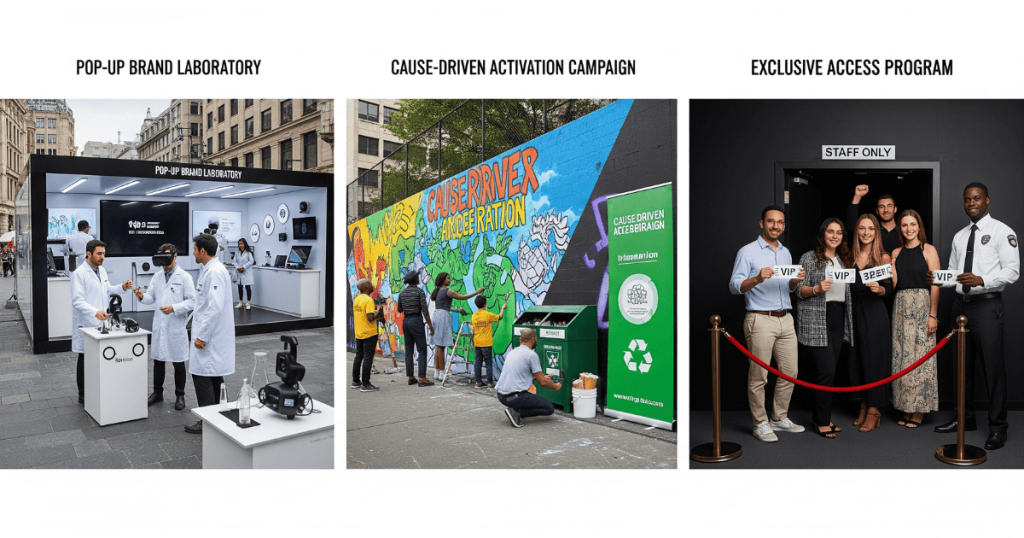
4. Pop-Up Brand Laboratories

Create temporary spaces that allow consumers to experiment with products, participate in workshops, or collaborate on creative projects. These brand partnership activations work particularly well for technology, beauty, or craft companies seeking to demonstrate product capabilities through hands-on experiences.

A smartphone manufacturer might establish pop-up photography studios at music festivals, offering professional lighting setups and editing workshops that showcase camera features while creating shareable content for attendees.

5. Cause-Driven Activation Campaigns

Align sponsorship activations with social causes that resonate with your brand values and audience priorities. These partnerships create emotional connections while generating positive publicity and demonstrating corporate social responsibility.

Corporate sponsorship ideas centered on environmental conservation, education, or community development often generate significant goodwill and media coverage. The key lies in choosing causes that authentically connect to your brand story rather than appearing opportunistic.

6. Exclusive Access Programs

Develop tiered experiences that reward different levels of engagement with increasingly valuable perks. This approach creates urgency while building long-term customer relationships through ongoing value delivery.

A luxury car brand sponsoring golf tournaments might offer test drives for general attendees, private lessons with pros for VIP customers, and exclusive course access for top-tier clients. Each tier reinforces brand positioning while providing appropriate value for different customer segments.

Content-Driven Activation Approaches

Innovative Sponsorship Strategies

7. Documentary and Storytelling Partnerships

Documentary-style content is a powerful way to bring depth to your sponsorship activation. Brands can partner with filmmakers, content creators, or influencers to produce meaningful stories about events, athletes, communities, or social causes connected to the sponsorship. This turns a simple partnership into a long-term brand storytelling asset.

These content pieces provide continuous value because people actively enjoy watching behind-the-scenes journeys, emotional narratives, and real human experiences. Modern sponsorship techniques use storytelling that entertains first and promotes second. When brand messages flow naturally inside a strong narrative, audiences are more likely to watch, remember, and share. This increases digital engagement and strengthens your brand’s cultural relevance.

8. User-Generated Content Campaigns

User-generated content campaigns empower your audience to participate directly and become authentic brand advocates. This approach encourages fans to create photos, videos, testimonials, or creative posts that reflect the sponsored event or brand experience. It also boosts organic reach because people trust content created by other users more than traditional ads.

Brands can improve participation by providing simple themes, templates, filters, or creative challenges. Clear guidelines keep content consistent while still giving users the freedom to express themselves. The most effective campaigns turn customers into co-creators, increasing engagement and building a strong community around the sponsorship. This approach also supports long-term content marketing because every submission becomes reusable brand content.

9. Educational Workshop Series

Educational activations help position your brand as a trusted expert. These workshops or masterclasses offer practical knowledge related to the event, industry, or audience needs. They add real value instead of only promoting a product.

For example, a financial services brand sponsoring a business conference can host workshops on investment basics, retirement planning, or smart money strategies. A tech brand sponsoring a gaming expo could run training sessions on cybersecurity or career development. These learning experiences build credibility, deepen brand trust, and give audiences a reason to engage beyond the main event.

Technology-Enhanced Activations

10. Augmented Reality Brand Overlays

Use AR technology to layer digital experiences onto physical environments, creating interactive elements that enhance rather than replace real-world interactions. These sponsorship campaign examples work particularly well for retail, entertainment, or tourism brands.

Sports sponsors can create AR apps that display player statistics, instant replays, or exclusive content when fans point their phones at specific areas of venues. This approach adds value to the live experience while generating valuable user data.

11. Blockchain and NFT Integrations

Explore emerging technologies to create unique digital assets, verify authenticity, or reward participation in sponsorship programs. These cutting-edge approaches appeal to tech-savvy audiences while demonstrating innovation leadership.

Brands can create limited-edition NFTs as commemorative items for sponsored events, use blockchain technology to verify product authenticity, or develop cryptocurrency reward systems that encourage ongoing engagement.

12. IoT-Connected Brand Experiences

Integrate Internet of Things devices to create seamless, data-rich interactions throughout sponsored events or partnerships. Smart sensors, beacons, and connected products can personalize experiences while gathering valuable insights.

A beverage company might distribute smart cups that track consumption patterns, provide personalized refill reminders, or unlock exclusive content when users interact with sponsor displays throughout an event venue.

Community-Building Activations

13. Brand Ambassador Networks

Brand ambassador programs help build strong community engagement around your sponsorship. Ambassadors can be influencers, loyal customers, or community leaders who share your message through their personal networks. This creates trust because people respond better to real recommendations than to traditional ads.

Successful programs give ambassadors real value. Brands can offer early product access, exclusive experiences, or learning opportunities that help them grow. When ambassadors feel supported, they promote the brand more authentically and strengthen the overall impact of the sponsorship.

14. Collaborative Creation Projects

Collaborative creation invites audiences to build something meaningful with your brand. This makes people feel involved and creates emotional ownership. It also produces unique content that highlights your brand values.

For example, an art supply company sponsoring a cultural event could let attendees help paint a mural or create a digital artwork. Each participant adds a small part, turning the final piece into a shared experience. This strengthens community connection and makes the sponsorship more memorable.

15. Long-Term Partnership Ecosystems

Long-term partnerships create value beyond a single event. These partnerships focus on ongoing engagement, shared content, and year-round teamwork. This helps brands stay connected with audiences over time.

For instance, automotive brands working with racing teams use the partnership all year. They release behind-the-scenes content, collaborate on product features, and host fan activities. This consistent approach builds stronger loyalty and makes it easier to measure impact and improve overall sponsorship valuation.

Measuring Activation Success

Effective sponsorship marketing ideas must include clear metrics for success measurement. Traditional awareness metrics remain important, but modern campaigns should also track engagement rates, user-generated content volume, social media reach, lead generation, and actual sales attribution.

Advanced measurement techniques include brand lift studies, sentiment analysis, share of voice tracking, and customer lifetime value calculations for acquired users. The most sophisticated programs use attribution modeling to understand how sponsorship touchpoints contribute to customer journeys across multiple channels.

Regular measurement and optimization ensure that innovative sponsorship strategies continue delivering value while identifying opportunities for improvement in future campaigns.

The Future of Brand Activation

The future of brand activation is changing fast. Technology is evolving, and consumer expectations are rising. Modern activation strategies must connect digital and physical experiences in one seamless journey. Brands that succeed will focus on authenticity, audience value, and strong alignment with core brand values.

Personalization will play a major role. Consumers now expect experiences tailored to their interests, behaviors, and purchase history. This shift pushes brands to use data-driven insights, AI-powered tools, and predictive analytics to deliver more relevant sponsorship engagement. Sustainability will also become a key part of activation planning, as audiences prefer eco-friendly events, ethical partnerships, and responsible brand actions.

Future brand activation will also rely on integrated marketing. This means combining social media campaigns, live events, influencer collaborations, experiential marketing, and digital storytelling into one unified strategy. When activation programs connect across multiple channels, consumers enjoy a smoother and more memorable journey. This increases engagement, strengthens brand trust, and improves sponsorship ROI.

The most important rule remains simple: great sponsorship activation must serve the audience first. When brands create meaningful experiences, people feel valued and understood. This emotional connection leads to stronger loyalty and ongoing engagement, not just short-term attention. Brands that keep innovating and refining their activation ideas will stay ahead of competitors.

Start using these proven strategies by choosing activation ideas that fit your brand values, audience needs, and business goals. The path to success lies in consistent execution, real audience feedback, and continuous optimization. With the right mix of creativity and measurement, sponsorship activation becomes a powerful long-term growth tool.

FAQs

1. What is sponsorship activation?

Sponsorship activation is the process of bringing a sponsorship to life through experiences, content, and activities that engage the audience. It goes beyond logo placement and focuses on creating real value for both the brand and the audience.

2. Why is sponsorship activation important for brands?

It is important because it increases engagement, builds emotional connections, and delivers stronger ROI than passive sponsorship. Good activation helps brands stand out and build long-term customer relationships.

3. What are examples of effective sponsorship activation ideas?

Examples include gamified social media challenges, VR experiences, pop-up events, user-generated content campaigns, educational workshops, AR overlays, and influencer or ambassador programs.

4. How do I measure sponsorship activation success?

You can measure success using metrics like engagement rate, reach, conversions, user-generated content volume, lead generation, sentiment analysis, and sales lift. Brands also use sponsorship valuation tools to calculate ROI.

5. How is sponsorship activation different from traditional sponsorship?

Traditional sponsorship focuses on visibility (logos, banners). Sponsorship activation focuses on engagement (experiences, interactions, content, storytelling).

6. What industries benefit most from sponsorship activation?

Sports, entertainment, technology, retail, travel, automotive, food & beverage, gaming, and finance all see strong results from activation-based partnerships.

7. How can small brands use sponsorship activation on a low budget?

Small brands can create simple activations such as social media contests, influencer collaborations, micro pop-up booths, user-generated content campaigns, or digital challenges that require minimal spending.

8. What digital tools can improve sponsorship activation?

AI personalization tools, AR filters, VR headsets, mobile apps, QR codes, IoT devices, social listening platforms, and CRM systems help brands create richer activation experiences.

9. What is gamified sponsorship activation?

Gamified sponsorship activation uses game elements—points, badges, leaderboards, challenges—to make the experience fun and interactive. It motivates audiences to participate more and stay engaged longer.

Global Sponsorship Deals: Legal Pitfalls That Could Cost You Millions

0
Global Sponsorship

Corporate sponsorship is now a multi-billion-dollar industry. Brands invest in global partnerships to reach new markets, build brand visibility, and strengthen partnership marketing strategies. The global sponsorship market continues to grow as companies explore sports sponsorships, entertainment deals, influencer partnerships, and cross-border brand collaborations. But behind every high-profile sponsorship agreement is a complex legal framework that many companies overlook.

When a sponsorship deal crosses international borders, the legal risks increase. Different countries follow different advertising laws, tax rules, data protection standards, and intellectual property regulations. A small mistake in a global sponsorship contract can lead to expensive penalties. It can damage brand reputation, affect sponsorship valuation, or even force the cancellation of a major deal.

This guide explains the biggest legal risks in international sponsorship deals. It also offers simple, practical steps to stay compliant with global regulations. Understanding these legal challenges helps brands, rights holders, and agencies protect revenue, avoid disputes, and build stronger global partnerships. This is essential for companies focused on safe expansion in global sports marketing, event sponsorships, and international brand activation.

Understanding Global Sponsorship Architecture

What Defines a Global Sponsor?

A global sponsor is a brand that works in many countries, not just one. These sponsors build partnerships across different regions to reach a wider audience.

Global sponsors usually have strong financial power. They also have well-known brands that people recognize in many parts of the world. Most of them already run international businesses, so global sponsorship deals fit naturally into their growth plans.

The global sponsorship market is growing fast. Many companies now invest in worldwide partnerships to reach new customers and gain global visibility. Businesses in sports, entertainment, technology, and consumer goods spend large amounts of money on global sponsorship contracts because these deals help them enter new markets and build stronger brand awareness.

Global Sponsorship

Anatomy of International Sponsorship Deals

International sponsorship deals are legal agreements between a sponsor and a rights holder. The sponsor gives money, products, or services. In return, they receive marketing benefits and brand exposure.

There are different types of sponsorship deals:

  • Financial sponsorships: The sponsor pays money directly.
  • In-kind sponsorships: The sponsor gives products or services instead of cash.
  • Media partnerships: The sponsor provides advertising space or promotional support.
  • Naming rights deals: The sponsor’s name is added to an event, venue, or team.

Global sponsorship deals are more complicated because they involve many countries. Each country has its own rules for advertising, taxes, contracts, and consumer protection. Brands must follow all these rules to avoid legal problems.

Cultural differences also matter. A sponsorship idea that works well in one country may not work in another. This is why global sponsorship agreements must be carefully written, reviewed, and planned.

Critical Legal Landmines in International Partnerships

Jurisdictional Compliance Challenges

Global sponsorship deals face major risks because every country follows different rules. What is allowed in one market may be illegal in another. This creates serious compliance problems for international partnerships.

For example, the European Union enforces strict data privacy rules under GDPR. These laws control how brands collect and use customer data during sponsorship campaigns. In contrast, China has strong content restrictions that limit what brands can show in global marketing materials. These differences make cross-border sponsorship compliance difficult.

Tax rules also change from country to country. Some governments apply withholding taxes, VAT, or other fees to sponsorship payments. If brands miscalculate these costs, they can face penalties or hidden expenses. Clear tax planning is essential for any global sponsorship contract.

Intellectual Property Vulnerabilities

International sponsorship partnerships often involve intellectual property, and this creates new legal risks. When two or more brands work together, they must protect their logos, trademarks, and creative assets in every region.

Trademark conflicts can occur if a sponsor uses a brand name or logo in a country where a similar mark is already registered. This is a common issue in global partnership marketing because campaigns run in many markets at once.

Copyright problems also arise when global sponsorship deals include videos, graphics, music, or digital content. Brands must decide who owns the content, where it can be used, and how long the rights last. Without clear IP protection, sponsors can face disputes that delay campaigns or increase costs.

Contract Ambiguities and Enforcement Issues

International sponsorship agreements are more complex than domestic contracts. They must address currency changes, political risks, cultural differences, and force-majeure situations. These elements affect how the partnership operates and how responsibilities are shared.

Enforcement becomes harder when partners are based in different countries. The contract must clearly state which country’s laws apply and where disputes will be resolved. This prevents confusion and reduces legal risk.

Language differences also create problems. Key terms can have different meanings when translated. In global sponsorship law, precise wording is critical. A small misunderstanding can lead to major contract disputes.

Regulatory Compliance Across Markets

Global Sponsorship

Advertising Standards and Content Restrictions

Advertising rules differ from country to country. This creates a challenge for brands running global sponsorship campaigns. Content that is acceptable in one market may violate strict cultural or legal standards in another.

Religious beliefs, political sensitivities, and social values influence advertising regulations worldwide. Sponsors must research local advertising laws, global marketing standards, and content restrictions before launching any campaign. This helps prevent legal violations and protects brand reputation.

Some industries also face special rules. For example, sports sponsorship may limit alcohol promotion or restrict gambling-related ads in certain regions. These industry-specific regulations require brands to adjust their messaging based on each market’s regulatory environment.

Data Privacy and Consumer Protection

Most modern sponsorship activities involve collecting user data, running digital contests, or tracking engagement. This makes data privacy compliance critical. Every country has its own rules, and brands must follow them to avoid fines.

For example, GDPR in Europe, CCPA in California, and China’s PIPL all set strict standards for handling personal information. Global sponsors must understand these data protection laws and ensure proper consent, storage, and disclosure practices.

Consumer protection laws also require clear transparency. Sponsored posts, influencer collaborations, or branded content must include proper disclosures. If brands hide sponsorship relationships, regulators may impose penalties and consumers may lose trust.

Marketing to younger audiences adds another layer of risk. Countries have different rules for advertising to minors. Sponsors must design campaigns that follow child safety standards, age-based restrictions, and ethical marketing guidelines to stay compliant.

Financial and Tax Implications

Cross-Border Payment Structures

Handling payments for global sponsorship deals is complex. Each country has its own tax rules, regulations, and reporting requirements. Factors like withholding tax, currency exchange laws, and transfer pricing can affect how money moves across borders.

To stay compliant, brands must follow international taxation rules and maintain clear financial documentation. Good tax planning helps reduce risks and avoid unexpected costs. Expert advice is important to structure payments in a way that is both efficient and legally safe.

Banks may also require extra checks for cross-border payments. This includes following anti–money laundering (AML) laws and meeting financial reporting standards. These rules must be built into the sponsorship contract to avoid any delays or penalties.

Revenue Recognition and Reporting

Different countries use different accounting standards for sponsorship revenue. This can create challenges for brands operating globally. Understanding how each region handles revenue recognition is essential for accurate financial planning.

Because many sponsorships now last several years, reporting becomes more complex. Multi-year deals may require detailed accounting methods to match revenue with the correct time period. Proper financial reporting, documentation, and tax compliance help keep the sponsorship transparent and legally aligned.

Building Bulletproof Global Partnership Strategies

Managing global sponsorship partnerships requires strong planning and the right legal setup. Brands must build a solid legal foundation before entering international deals.

Working with local legal experts in each country is essential. These professionals understand local regulations, cultural differences, and hidden compliance risks that foreign companies may not see.

Regular compliance audits help find problems early. Monitoring new laws and regulatory changes ensures the partnership stays compliant throughout its entire lifecycle.

A detailed due diligence process is also important. It should check a partner’s business background, legal history, and reputation in their market. This helps avoid risky partnerships and reduces future legal complications.

The global sponsorship landscape changes quickly. New regulations, technologies, and market trends appear often. Organizations that invest in strong legal planning and risk management are better prepared for these challenges.

Understanding these legal factors leads to smarter decisions and smoother international operations. In the long run, proper legal preparation protects the business and creates stronger, more successful global sponsorship partnerships.

FAQs

1. What are the biggest legal risks in global sponsorship deals?

The biggest risks include different advertising laws, tax rules, data privacy issues, and intellectual property conflicts. These risks grow when a deal involves many countries.

2. Why is compliance important in international sponsorships?

Compliance protects the brand from fines, lawsuits, and reputational damage. It also keeps the partnership legal and stable across all markets.

3. How do tax rules affect cross-border sponsorship payments?

Each country has its own tax system. Some apply withholding taxes, VAT, or reporting requirements. If brands miscalculate these costs, they may face penalties.

4. Why are intellectual property rights a major concern in global partnerships?

Brands must protect logos, trademarks, and content in every country. Without proper IP agreements, sponsors may face trademark conflicts or copyright disputes.

5. What advertising restrictions should brands consider in global markets?

Some countries restrict political, religious, alcohol, or gambling content. A message that is allowed in one market may violate laws in another.

6. How does data privacy affect international sponsorship campaigns?

Different countries have strict data laws like GDPR, CCPA, and China’s PIPL. Brands must collect, store, and use customer data legally to avoid fines.

7. Why do global sponsorship contracts need clear legal terms?

International contracts involve multiple laws, languages, currencies, and jurisdictions. Clear terms prevent confusion, reduce disputes, and protect both partners.

How to Build a Winning Brand Partnership Strategy for Startups

0
Brand Partnership Strategy

Brand partnership strategy is one of the most effective ways for startups to grow in competitive markets. Building a successful startup takes more than a strong product or service. It requires smart brand collaborations, strategic alliances, and well-planned partnership marketing efforts that help businesses share resources, expand reach, and create mutual value.

Many startups struggle to compete with established brands that have larger budgets and strong customer trust. A well-executed partnership marketing strategy can help level the playing field. By forming business partnerships with complementary companies, startups can access new distribution channels, reach untapped customer segments, and improve brand credibility without increasing marketing costs.

This guide breaks down how to build an effective brand partnership framework that delivers measurable results. Whether your goal is to boost brand awareness, enter new markets, or strengthen your product offering, understanding startup partnerships, co-marketing strategies, and brand collaboration models will help you identify the right opportunities and build long-term, high-impact partnerships.

What is a Brand Partnership?

A brand partnership is a strategic alliance between two or more companies that collaborate to achieve mutual business objectives. Unlike traditional vendor relationships, these partnerships involve shared resources, co-created content, or joint marketing efforts that benefit all parties involved.

Brand Partnership

Brand partnerships take various forms depending on the goals and industries involved. Co-marketing partnerships involve businesses promoting each other’s products or services to their respective audiences. Product partnerships might include co-developing new offerings or integrating complementary services. Distribution partnerships help companies access new sales channels or geographic markets they couldn’t reach independently.

The key distinction between brand partnerships and other business relationships lies in the mutual value creation. Rather than a simple transaction, successful startup marketing partnerships create synergies where the combined effort produces greater results than each company could achieve individually.

What is a partnership marketing strategy?

Partnership marketing strategy encompasses the systematic approach businesses use to identify, develop, and manage collaborative relationships that drive growth. This business partnership model requires careful planning to ensure alignment between partners’ goals, values, and target audiences.

Effective partnership marketing strategies begin with clear objectives. Companies must define what they hope to achieve through collaboration, whether that’s expanding market reach, enhancing product capabilities, or improving operational efficiency. These goals inform partner selection criteria and help establish metrics for measuring success.

Brand Partnership Strategy

The strategic alliance agreement forms the foundation of successful partnerships. This document outlines each party’s responsibilities, resource contributions, and expected outcomes. It also addresses intellectual property rights, revenue sharing, and termination procedures to prevent conflicts and ensure smooth collaboration.

Partner marketing requires ongoing coordination and communication between teams. Companies must establish regular check-ins, shared performance dashboards, and clear escalation procedures to address challenges quickly and maintain momentum throughout the partnership lifecycle.

How to Build Strategic Brand Partnerships

Identify Your Partnership Objectives

The foundation of any successful strategic brand partnership starts with clear and measurable goals. Startups should define what they want to achieve through partnership marketing, such as reaching new customer segments, improving product value, lowering customer acquisition costs, or expanding into new markets. Well-defined objectives make it easier to evaluate potential partners and design collaborations that align with your overall brand growth strategy.

It’s also important to balance short-term wins with long-term impact. While quick revenue gains or lead generation may be attractive, strategic alliances that strengthen brand credibility, unlock industry expertise, or improve market positioning often deliver more sustainable value over time.

Research and Identify Potential Partners

The best brand partnerships are built with companies that share a similar audience but offer complementary products or services rather than direct competition. Look closely at a potential partner’s brand values, customer demographics, and market reputation to ensure alignment with your startup’s mission and positioning.

You can discover business collaboration opportunities through multiple channels. Industry conferences, networking events, startup communities, and online forums are great places to connect with like-minded brands. Social media platforms, LinkedIn outreach, and business directories can also help you identify and research potential co-marketing partners.

Evaluate Partnership Compatibility

Strong partnerships go beyond surface-level business fit. Cultural alignment plays a major role in long-term partnership success, especially when teams collaborate closely. Assess how potential partners communicate, make decisions, and handle conflict to determine how smoothly your teams will work together.

Financial health and growth trajectory also matter. Partnering with financially unstable companies can expose your startup to unnecessary risk, while brands with complementary growth plans are more likely to create balanced and sustainable collaborative partnerships.

Structure the Partnership Agreement

A clear and well-structured partnership agreement is essential for avoiding confusion and protecting both parties. Define roles, responsibilities, timelines, and expectations upfront. Important elements include resource sharing, performance benchmarks, intellectual property ownership, and revenue or cost-sharing models.

Since startup environments change quickly, build flexibility into your strategic alliance framework. Include clauses for regular reviews and adjustments so the partnership can evolve as business needs, goals, and market conditions shift.

Execute and Manage the Partnership

Once the partnership launches, strong execution becomes the priority. Communicate the collaboration clearly to internal teams and external stakeholders to ensure alignment. Use shared project management tools, regular check-ins, and clear workflows to keep brand collaboration initiatives on track.

Ongoing monitoring is key to long-term success. Track relevant KPIs, evaluate results consistently, and address challenges early. Effective partnership management requires continuous optimization, open communication, and a commitment to delivering value for all partners involved.

Benefits of Brand Partnerships for Startups

Benefits of Brand Partnership

Strategic brand partnerships offer startups access to resources and capabilities that would be expensive or time-consuming to develop independently. These collaborative brand relationships can significantly accelerate growth while reducing financial risk.

Market Expansion and Customer Acquisition

Partnerships provide access to established customer bases and distribution channels. Rather than building brand awareness from scratch, startups can leverage their partners’ existing relationships and credibility to reach new audiences more efficiently.

Resource Optimization

Strategic alliances allow startups to access specialized expertise, technology, or infrastructure without major capital investments. This resource sharing enables companies to focus on their core competencies while benefiting from partners’ strengths in other areas.

Enhanced Credibility and Trust

Association with established brands can boost a startup’s credibility in the marketplace. Customer trust often transfers between partner brands, helping new companies overcome the credibility challenges that typically face unknown businesses.

Innovation and Product Development

Collaborative partnerships often spark innovation by combining different perspectives, technologies, or market insights. Joint product development initiatives can create unique offerings that differentiate both partners from competitors.

Cost-Effective Marketing

Partnership marketing strategies typically cost less than traditional advertising while delivering higher engagement rates. Shared marketing campaigns allow startups to access professional-quality content and broader audience reach at a fraction of the cost of independent campaigns.

Key Components of Successful Brand Partnerships

Aligned Strategic Vision

The most successful startup partnerships involve companies with complementary long-term visions rather than just short-term tactical goals. When partners share similar values and growth aspirations, they’re more likely to invest time and resources needed for meaningful collaboration.

Clear Communication Frameworks

Establish regular communication cadences and standardized reporting formats from the partnership’s beginning. Transparency about challenges, opportunities, and performance metrics helps maintain trust and enables quick problem resolution.

Mutual Value Creation

Ensure that partnership marketing strategies benefit all parties relatively equally. Imbalanced relationships often fail because one partner loses motivation to maintain their commitments when the benefits don’t justify the required investment.

Performance Measurement Systems

Implement tracking systems that measure both individual partner contributions and combined partnership outcomes. Regular performance reviews help identify optimization opportunities and demonstrate return on investment to stakeholders.

Flexibility and Adaptability

Build mechanisms for partnership evolution as companies grow and market conditions change. The most successful strategic alliances adapt to new opportunities while maintaining their core collaborative principles.

Building Your Partnership Success Framework

Building a long-term brand partnership framework requires more than enthusiasm—it demands clear planning, consistency, and strategic thinking. Startups should begin by setting up structured internal processes for partner discovery, partnership evaluation, and relationship management. Tracking past collaborations and documenting outcomes helps create a repeatable partnership marketing system that improves decision-making over time.

Strong business collaborations are often powered by relationships, not just contracts. While partnership agreements set expectations, real success comes from trust, open communication, and shared commitment. Regular check-ins, informal conversations, and cross-team collaboration help strengthen strategic alliances and keep both partners aligned as goals evolve.

Instead of relying on a single collaboration, startups benefit from building a diverse partnership portfolio. Working with multiple complementary brands reduces dependency, minimizes risk, and creates more opportunities for market expansion, co-marketing campaigns, and knowledge sharing.

As partnership marketing strategies continue to evolve with digital tools, automation, and data-driven insights, startups that understand the fundamentals of strategic partnership development will stay ahead. Those who invest in scalable collaboration models and meaningful brand relationships will be better positioned to adapt, innovate, and drive sustainable growth in an increasingly connected business landscape.

Conclsuion

A well-defined brand partnership strategy can be a powerful growth engine for startups aiming to scale efficiently in competitive markets. By leveraging strategic alliances, co-marketing initiatives, and collaborative brand relationships, startups can unlock new customer segments, strengthen brand positioning, and accelerate market entry without excessive spending.

The most successful partnership marketing strategies are built on clear goals, strong partner alignment, and continuous performance tracking. When startups focus on mutual value creation, transparent communication, and adaptable partnership frameworks, brand collaborations evolve into long-term assets rather than short-term campaigns. As digital ecosystems expand and cross-brand collaboration becomes more common, startups that master business partnerships and brand collaboration models will gain a lasting competitive advantage and sustainable growth.

FAQs

How does a brand partnership strategy help startup growth?

A brand partnership strategy helps startups drive growth by expanding market reach, reducing customer acquisition costs, and leveraging shared audiences. Through strategic brand collaborations, startups gain visibility, credibility, and faster access to new markets.

What is the difference between partnership marketing and traditional marketing?

Partnership marketing focuses on collaborative marketing efforts where two or more brands share resources, audiences, and campaigns. Unlike traditional marketing, it emphasizes mutual value creation rather than one-sided promotion.

Which brand collaboration models work best for startups?

Popular brand collaboration models for startups include co-marketing partnerships, product integration partnerships, distribution alliances, and affiliate marketing programs, depending on business goals and target audiences.

What makes a strategic alliance successful for startups?

Successful strategic alliances rely on aligned goals, compatible brand values, clear partnership agreements, and consistent communication. Strong partnership management and performance measurement are critical for long-term success.

How can startups measure partnership marketing success?

Startups can track partnership success using KPIs such as lead generation, customer acquisition, brand awareness growth, engagement rates, revenue impact, and overall return on investment (ROI) from the partnership.

Global Brand Partnership Marketing: Your Complete Strategy Guide

0
Global Brand Partnership Marketing

The global partnership marketing industry has exploded into a $15 billion ecosystem, fundamentally changing how brands connect with customers worldwide. Companies across all sectors are discovering that strategic brand collaboration can accelerate growth, expand market reach, and create authentic connections with new audiences in ways traditional advertising simply cannot match.

Partnership marketing represents a shift from competing in isolation to thriving through strategic alliances. Whether you’re exploring affiliate marketing channels, seeking acceleration partners for rapid expansion, or building comprehensive collaboration frameworks, understanding the nuances of global partnership marketing has become essential for sustainable business growth.

This guide will walk you through proven marketing strategies, show you how to develop an effective marketing plan, and provide insights into building a career as a partnership manager in this dynamic field.

What is global partner marketing?

Global Brand Partnership Marketing

Global partner marketing is a partner marketing strategy where brands build brand partnerships with companies in different countries. Instead of managing all promotions alone, businesses work with affiliates, resellers, influencers, and strategic partnerships to grow faster.

This approach supports international expansion by using partners who already understand global markets and local customer needs. These partners help with customer acquisition, brand visibility, and trust building in new regions.

Global partner marketing also reduces marketing costs and business risk. Many companies use affiliate marketing and long-term strategic partnerships to increase revenue and scale operations worldwide. The focus is on shared goals, mutual growth, and sustainable global success.

Why Global Brand Partnership Marketing Matters

Why Global Brand Partnership Marketing Matters

Global brand partnership marketing matters because it helps businesses grow efficiently in competitive global markets. Through strong brand partnerships, companies can expand their reach without relying only on traditional advertising channels.

This strategy supports international expansion by working with strategic partners who understand local customer behavior and regional trends. These collaborations improve customer acquisition and reduce the risk of entering new markets.

Global partner marketing also builds trust and credibility. When brands collaborate through affiliate marketing, co-branding, or long-term partner marketing programs, customers feel more confident engaging with new products or services. Overall, global brand partnership marketing drives sustainable growth, increases brand awareness, and creates long-term business value.

Types of Brand Collaboration Models

Types of Brand Collaboration Models

Brand collaboration can take many forms depending on business goals, market reach, and available resources. Each model plays a different role in a successful partner marketing strategy. Below is a detailed explanation of the most effective brand collaboration models used in global markets.

Affiliate Marketing Partnerships

Affiliate marketing is one of the easiest and most cost-effective forms of brand collaboration. In this model, businesses partner with affiliates who promote products or services through websites, blogs, social media, or email marketing. Affiliates earn a commission for every sale, lead, or action they generate.

This performance-based marketing approach helps companies control costs and reduce financial risk. It is especially effective for customer acquisition and online sales growth. Affiliate marketing also supports international expansion, as global affiliates can promote products in local markets.

Successful affiliate programs rely on strong tracking systems, transparent commission structures, and regular communication. Marketing managers must provide affiliates with promotional assets, clear guidelines, and ongoing support to maintain long-term partner relationships.

Strategic Business Partnerships

Strategic business partnerships involve deeper and more long-term collaboration between brands. These strategic partnerships often include shared resources, joint marketing campaigns, co-developed products, or integrated services. Many technology, finance, and SaaS companies use this model to strengthen their market position.

This collaboration model helps brands enter global markets, improve product value, and increase revenue through shared expertise. Strategic partners often align their goals, target audiences, and business strategies to achieve mutual growth.

A clear marketing plan is critical for success. It should define responsibilities, resource allocation, timelines, and success metrics. Strong alignment and regular performance reviews ensure that both brands benefit equally from the partnership.

Influencer and Content Creator Partnerships

Influencer and content creator partnerships focus on trust, engagement, and authenticity. Brands collaborate with influencers who have established audiences and strong credibility within specific niches. These partnerships support brand awareness, engagement, and targeted customer acquisition.

This brand collaboration model can include sponsored content, product reviews, social media campaigns, or long-term brand ambassador programs. Influencer partnerships are especially effective in digital marketing and social commerce.

Success depends on audience alignment and authentic messaging. Brands should prioritize storytelling and value-driven content instead of aggressive promotion. When done correctly, influencer marketing strengthens brand credibility and supports long-term partner marketing programs.

Co-Branding and Joint Marketing Campaigns

Co-branding partnerships involve two or more brands working together on a shared product, service, or campaign. These collaborations combine brand strengths to create higher perceived value for customers. Co-branding is often used to boost brand visibility and enter new customer segments.

Joint marketing campaigns help reduce marketing costs while increasing reach. They are effective for product launches, seasonal promotions, and market entry strategies. Clear brand guidelines and consistent messaging are essential for success.

Technology and Integration Partnerships

Technology partnerships focus on integrating products, platforms, or services to create better customer experiences. These partnerships are common in software, fintech, and e-commerce industries. They support business growth, product innovation, and customer retention.

By offering integrated solutions, brands increase value and improve customer satisfaction. These partnerships also strengthen long-term relationships and support scalable global partner marketing strategies.

Building Effective Marketing Strategies for Partnerships

Global Brand Partnership Marketing

Market Research and Partner Identification

Successful partnership marketing begins with thorough market analysis. Identify companies whose audiences overlap with yours but whose products or services complement rather than compete with your offerings. Acceleration partners—organizations that can rapidly expand your reach—often emerge from unexpected industries.

Research potential partners’ reputation, financial stability, and alignment with your brand values. A partnership with a company facing legal troubles or ethical issues can damage your brand reputation regardless of short-term benefits.

Developing Partnership Frameworks

Create standardized processes for evaluating, onboarding, and managing partnerships. This framework should include legal considerations, performance metrics, communication protocols, and termination procedures.

Your marketing plan should outline specific gals for each partnership type. Affiliate marketing might focus on conversion rates and customer acquisition costs, while strategic partnerships might emphasize market expansion and revenue growth.

Performance Measurement and Optimization

Establish clear metrics before launching any partnership initiative. Common performance indicators include:

  • Customer acquisition cost through partnership channels
  • Revenue generated from collaborative efforts
  • Brand awareness lift in target markets
  • Customer lifetime value from partnership-acquired customers

Regular performance reviews allow for strategy optimization and relationship strengthening. Marketing managers should schedule quarterly assessments to evaluate partnership effectiveness and identify improvement opportunities.

Career Opportunities: Partnership Manager Resume Essentials

The growing partnership marketing industry creates numerous career opportunities for marketing professionals. A strong partnership manager resume should highlight both strategic thinking and relationship management skills.

Essential Skills and Qualifications

Partnership managers need a unique combination of analytical and interpersonal abilities. Technical skills include data analysis, project management, and marketing automation platforms. Soft skills encompass negotiation, communication, and cultural sensitivity for global partnerships.

Educational backgrounds vary widely in this field. Partnership Marketing manager roles often require business degrees, but experience and demonstrated results frequently matter more than formal credentials.

Building Relevant Experience

Entry-level marketing professionals can gain partnership experience through affiliate program management, influencer outreach, or cross-promotional campaigns. Volunteer work with nonprofit organizations often provides valuable partnership experience while building professional networks.

Document specific achievements on your partnership manager resume. Quantify results whenever possible: “Managed affiliate program generating $2.3M annual revenue through 150+ active partners” demonstrates concrete value creation.

Creating Your Global Partnership Marketing Plan

Strategic Planning Process

Start with clear objectives aligned with overall business goals. Your marketing plan should specify target markets, desired partnership types, resource allocation, and timeline expectations. Consider both short-term tactical partnerships and long-term strategic alliances.

Conduct competitive analysis to understand how industry leaders approach partnership marketing. Identify gaps in current partnership ecosystems that your company could fill through innovative collaboration models.

Implementation and Management

Successful implementation requires dedicated resources and clear accountability. Assign specific team members to manage different partnership categories, ensuring consistent communication and relationship development.

Develop standardized onboarding processes for new partners. This might include training materials, brand guidelines, marketing assets, and performance expectations. Consistent onboarding improves partnership success rates and reduces management overhead.

Scaling Across Global Markets

International expansion through partnerships requires cultural sensitivity and local market knowledge. Acceleration partners in new geographic regions provide invaluable insights into consumer behaviour, regulatory requirements, and competitive landscapes.

Consider partnering with local marketing agencies or consultants who understand regional nuances. These relationships can prevent costly mistakes while accelerating market entry timelines.

Maximizing Partnership Marketing Success

Global brand partnership marketing represents a fundamental shift toward collaborative growth strategies. Companies that master these approaches gain competitive advantages through expanded reach, shared resources, and authentic audience connections.

Success requires strategic thinking, systematic implementation, and ongoing relationship management. Whether you’re developing affiliate marketing programs, seeking acceleration partners for rapid expansion, or building a career as a partnership manager, focus on creating genuine value for all stakeholders.

The partnership marketing landscape will continue evolving as new technologies and platforms emerge. Companies that build flexible partnership frameworks and maintain strong relationship management practices will thrive in this collaborative economy.

Start by identifying one potential partnership opportunity that aligns with your business objectives. Develop a pilot program with clear success metrics, then scale successful models across your organization. The partnerships you build today will define your competitive position in tomorrow’s global marketplace.

FAQs

What is global brand partnership marketing?

Global brand partnership marketing is a strategy where two or more companies collaborate across markets to share audiences, resources, and expertise. These partnerships help brands expand internationally, reduce marketing costs, and build authentic customer relationships through mutual value creation.

How is partnership marketing different from traditional advertising?

Unlike traditional advertising, which relies on paid media placements, partnership marketing focuses on long-term collaboration. It leverages trust, shared audiences, and co-created value, making it more cost-effective and often more credible to consumers.

What are the most common types of brand partnerships?

The most common brand partnership models include affiliate marketing partnerships, strategic business alliances, influencer and content creator collaborations, and co-branded product or service partnerships. Each model serves different business goals and growth stages.

How do you choose the right brand partner?

The right brand partner should share similar values, have a complementary audience, and offer clear mutual benefits. Businesses should also evaluate reputation, market position, financial stability, and long-term strategic alignment before forming a partnership.

What metrics are used to measure partnership marketing success?

Partnership marketing success is typically measured using customer acquisition cost, revenue generated, conversion rates, brand awareness lift, and customer lifetime value. Clear KPIs should be defined before launching any partnership campaign.

What skills are needed to become a partnership marketing manager?

A partnership marketing manager needs strong relationship-building, negotiation, and communication skills, along with data analysis, strategic planning, and project management abilities. Experience managing affiliates, influencers, or strategic alliances is highly valuable.

Virtual Events Sponsorship on the Rise: What That Means for Engaging Audiences Online

0
virtual event sponsorship

Virtual events have changed the way businesses engage with audiences. The sponsorship industry as a whole has experienced a significant transformation, offering brands better ways to connect with consumers in digital environments.

These days, companies are pouring billions of dollars into virtual events sponsorship. This move has occurred for a number of reasons, as virtual events have some distinct advantages over their face-to-face counterparts. They have global reach, come with expansive data and are often less expensive than in-person events.

This guide will delve into how virtual event sponsorship operates, the reasons it provides high ROI, and real tactics to increase audience engagement. You will discover tactics that successful brands use to become the best in a crowded digital event landscape.

What is Virtual Events Sponsorship?

Sponsorship for virtual events refers to brands paying to have their products or services promoted during online events. These occasions consist of webinars, virtual events, virtual trade fairs, digital conferences and online workshops.

Sponsors get a number of benefits in return for their investment. Typical sponsorship levels include logo placement, public speaking opportunities, ad hoc pre-event virtual booth space, and attendee data. The sponsorship model is a convention that can be ported over from traditional events to digital ones.

The virtual events industry exploded 400 percent from 2020 to 2023. This stunning expansion opened up new sponsorship possibilities that hadn’t been available before. Interactive features like polls, chat features and virtual network rooms can now be sponsored by brands.

Key aspects of virtual event sponsorship are:

  • Brand exposure on digital banners and logos
  • Registration forms and booth visits for lead generation
  • Sponsored session content marketing options
  • Attendee interactions and data gathering.
  • Artificial intelligence (and/or) Algorithm for enabling networking in virtual meetings centers

Benefits of Virtual Event Sponsorship

virtual event sponsorship

Global Reach Without Geographic Limits

“What would running a virtual event look like for them?” In New York, a company can host a virtual conference and connect with attendees in Tokyo, London and Sydney, for example, all at once.

This broader reach also allows sponsors to reach broader, more diverse audiences. When made into virtual events, they experience a 200-300% rise in average attendance.

Enhanced Data and Analytics

the level of detail on metrics provided by digital platforms, even physical events cannot come close to that. Sponsors get access to live information on attendee activity, engagement and content interest.

Common metrics include:

  • Session attendance duration
  • Booth visit frequency and time spent visiting the booth.
  • Downloaded content and resources
  • Chat participation and networking activity
  • Quality lead scores on engagement

Cost-Effective Marketing Investment

Sponsorship of virtual events usually runs 50-70% cheaper than their live event counterpart. Sponsors get to save cost on travel and accommodation, and on having to pay someone to construct their booth while getting to a larger audience.

The lower costs also make it possible for brands to sponsor more than one event, or to spring for a higher-level sponsorship tier. This freedom allows for better use of event marketing budgets.

Increased Engagement Opportunities

Sponsor engagement is increased through interactive elements on virtual platforms. These range from live polls and Q&A sessions to virtual product demos and one-on-one video meetings.

Attendees engage with interactive elements longer than a traditional sponsorship play. Sponsors experience better quality leads because qualified visitors show a high level of interest in their products or services.

Digital Sponsorship ROI: Measuring Success

Digital Sponsorship ROI

Key Performance Indicators (KPIs)

For a virtual sponsorship program to be successful, tracking is required to monitor metrics that indicate return on investment. The most important KPIs include:

Lead Generation Metrics:

  • Number of qualified leads generated
  • Cost per lead against other marketing channels
  • Lead-to-customer conversion rates
  • Deal size from leads sourced from events average deal size from event-generated leads

Engagement Metrics:

  • Brand mention frequency during events
  • Social media engagement and shares
  • Content download rates
  • The length of time spent visiting virtual booth and return visits

Brand Awareness Metrics:

  • Brand recall surveys post-event
  • Web traffic surges during and after events
  • Social media follower growth
  • Event feedback Based on brand sentiment analysis

Calculating Digital Sponsorship ROI

The general ROI equation of virtual event sponsorship is:

ROI = (revenue generated – sponsorship cost) / sponsorship cost * 100

But virtual events offer additional value that conventional ROI metrics may overlook — things like:

  • Branding for months and years with recorded sessions
  • Value of content marketing from sponsored webinars and presentations
  • Virtual networking as a tool for developing customer relationship
  • Market intelligence based on the data and feedback from attendees

Benchmarking Performance

And here we are, trying to understand how to read the online tea leaves in a world where so much has yet to settle. Here’s my attempt to make sense of it all: Industry benchmarks can help sponsors asses their virtual events performance:

  • Average CTR on virtual event sponsors: 8-12%
  • Typical lead conversion rates: 15-25%
  • Medium cost of a lead: $50-150 per industry
  • Brand Recall: 60-80% among active sponsors

Benchmark against these metrics and see where you can improve, while perfecting your sponsor investment strategy going forward.

Online Event Engagement Strategies

Pre-Event Engagement

The success of virtual events sponsorship doesn’t start when the event does. Event promotion prior to the event prepares and generates excitement, driving better attendance.

Content Marketing Approach:
So generate content that’s makes your brand look like an industry leader. Publish blog posts, whitepapers and case studies on the topic of the events. These contents could offer certain insights (value) and have a ‘subtle’ promotion to your sponsorship.

Social Media Promotion:
Get involved in dialogue by using event tags and sharing key insights. Post a behind-the-scenes look at your team getting ready for the conference. Network with other speakers and sponsors.

Email Marketing:
Invite your customers and prospects to their own personalized meeting. Be sure to offer attendees something special to look forward to such as premium content or first looks at event material.

During-Event Engagement

Engagement at virtual events is key to ensuring the highest value for sponsors. There is seldom a payoff for so-called passive sponsorship in online worlds.

Interactive Presentations:
Run interactive sessions, that blend an educational element with an understated plug of your product. Keep your audience engaged with polls, quizzes, and interactive demonstrations.

Virtual Booth Strategy:
Create interactive, explorable virtual booths. Add video demos, downloadable resources, and clear contact options. Person your booth with experienced people who can immediately respond to questions.

Chat Participation:
Join chats and stay active within the event. Answer questions, provide insight, and engage with the audience. This real-time interaction fosters relationships and showcases expertise.

Networking Facilitation:
Leverage virtual networking capabilities to meet attendees in one-on-ones. Put meetings on the books and keep the dialogue going post event.

Post-Event Follow-up

The most successful sponsors continue to engage after virtual events are over. Now to do a follow up post while you still have their interest…

Lead Nurturing:
Follow up with hot prospects 24-48 hours after the show. Use the information that you gained at event to reference specific conversations that you had or interests the person is known to have mentioned.

Content Sharing:
Provide event video recordings, slide decks, and other resources for people who would like to view these things. It does provide continued value and works to keep your brand top of mind.

Feedback Collection:
Obtain a post-event experience and feedback from visitors about your sponsorship. Leverage this insight to enhance future virtual event strategies.

What is Virtual Event Sponsorship Best Practices for Success

Choose the Right Events

Not every virtual event delivers the same value for sponsors. Research not only the type of crowd that usually attends the event, but the organizer’s reputation and anticipated attendance, before signing on as a sponsor.

Here’s what to ask yourself as you’re thinking through virtual events:

  • Your audience is in line with your ideal customers
  • Suitability of the event format for your marketing objectives
  • The virtual event production experience of the organizer
  • Sponsor integration by technology platform capabilities
  • Pricing plan that suits your pocket and return of investment expectations

Develop Compelling Sponsor Content

Virtual audiences don’t have the same attention spans as in-person attendees. Make the type of content that demands attention and provides value, fast.

Content Guidelines:

  • Try to make presentations shorter than 20 minutes
  • Utilize graphics to keep them engaged
  • Add in some interactive pieces every 3-5 minutes
  • Provide clear calls-to-action throughout content
  • Provide actionable insights that attendees can apply straight away

Leverage Technology Effectively

There are many features sponsors can use on virtual event platforms. Knowing about these features is critical to maximizing sponsorship return.

Platform Features to Explore:

  • Product demonstrations with live streaming features
  • Ability to use breakout rooms for smaller conversations
  • Gamification elements to increase engagement
  • CRM system integration to capture leads directly and effortlessly
  • Real-time performance tracking and analytics dashboards

Build Authentic Relationships

The “in” thing may feel monotonous and disengaging, which only serves to make genuine relationship building that much more critical. Work towards real connections, rather than aggressive sales tactics.

Relationship Building Strategies:

  • Share personal stories in a speech or presentation
  • Answer questions and comments with care
  • Follow up with decks and customized messages after the event.
  • Deliver value without thinking of your rewards upfront
  • Long-Term Relationship with Prospects

Virtual Event Sponsorship Mistakes to Avoid

Pretending Virtual Events Are Physical Events

Virtual events need a new way of thinking than their in-person counterparts. Sponsors that just port over physical event techniques to virtual don’t do nearly as well.

Key Differences to Consider:

  • Smaller attention spans call for increased frequency of engagement
  • Technological snafus may hijack sponsor presentations.
  • You network in various ways and in various places
  • Follow-up needs to be more targeted and in-the-moment

Neglecting Technical Preparation

Sponsors can have their virtual event experiences ruined if technology fails. Also test individual technology before the presentation starts.

Technical Checklist:

  • Test and/or measure their internet connection speed and quality
  • Verify audio and video quality
  • Practice using platform features
  • Have a plan for technical problems
  • Educate staff on how to use your platform

Focusing Only on Lead Generation

By all means, lead-generating is crucial, but when sponsors are only targeting those that will buy today, they can miss out on more generalized branding opportunities.

Balanced Approach:

  • Integrate lead generation and brand awareness goals
  • Share educational resources in addition to promotional content
  • Develop ‘business builds’ rather than chasing sales
  • Track multiple metrics in addition to lead volume to determine success

The Future of Sponsorship for Virtual Events

Hybrid Event Integration

The future of event sponsorship is a hybrid of online and offline. Hybrid events, for sponsors, are the best of both worlds: Global access coupled with personal connection possibilities.

Sponsors need to find what works in the new digital world and the old physical one. This depends on the flexibility of content and engagement strategies to fit to various audience segments.

Advanced Analytics and AI

AI will change sponsor perceptions of and engagement with virtual event audiences. Analytics driven by AI will generate more nuanced understanding of what attendees want and what they do.

Future capabilities may include:

  • Real-time sentiment analysis during presentations
  • Engagement triggered predictive lead scoring
  • Automated personalization of sponsor content
  • Sophisticated targeting based on audience segmentation

Immersive Technologies

VR & AR: VR and AR technologies will make sponsorship experiences more immersive. They will blur the boundary between virtual events and physical ones.

Early movers in immersive tech will enjoy serious competitive advantages as these tools become both cheaper and more widely available.

Getting the Most Out of Your Virtual Event Sponsorship

Sponsorship of virtual events is a major opportunity for brands that can pivot their marketing strategies. For the success you need to understand the dynamics of virtual worlds and create audience relevant engagement.

The secret to virtual event sponsorship success is adding real value to your event attendees and forming real relationships. Education, engagement, and the long game are where the big bucks for sponsors are.

Begin by choosing the events that are a good match for your ideal audience and who you want to do business with. Create highly-engaging content that captivates virtual audiences and make the most out of the functionalities of the platforms. Count on success and keep testing (especially, measure your progress and up your game every time based on data).

Sponsor opportunities for virtual events will only improve as technology and attendee demands evolve. Brands that stay ahead of these trends and adjust their tactics will get more ROI from their digital sponsorships, and stronger connections with their target audiences.

FAQs

What is virtual event sponsorship?

Virtual event sponsorship is when a brand pays to promote its products or services during online events such as webinars, virtual conferences, digital trade shows, or online workshops. Sponsors gain visibility through logo placement, sponsored sessions, virtual booths, and access to attendee engagement data.

Why is virtual event sponsorship growing so fast?

Virtual event sponsorship is growing because it offers global reach, lower costs, and stronger data insights compared to in-person events. Brands can reach larger audiences, track engagement in real time, and generate high-quality leads without travel or venue expenses.

How do brands measure ROI from virtual event sponsorships?

Brands measure virtual event sponsorship ROI using metrics such as qualified leads, cost per lead, engagement rates, session attendance, booth interactions, and post-event conversions. Brand awareness metrics like website traffic, social mentions, and recall surveys also play an important role.

What are the best ways to engage audiences during sponsored virtual events?

The most effective engagement strategies include interactive presentations, live polls, Q&A sessions, virtual product demos, chat participation, and one-to-one networking. These tools keep attendees active and help sponsors build meaningful connections.

What mistakes should brands avoid in virtual event sponsorship?

Common mistakes include treating virtual events like physical ones, neglecting technical preparation, focusing only on lead generation, and ignoring post-event follow-up. Successful sponsors balance branding and lead goals while delivering genuine value to attendees.

0FansLike

EDITOR PICKS